Rome City Guide – The Perfect 3-Day Itinerary
Destination: Rome, Italy
Recommended Stay: 2–3 days
Travel Style: City Trip
Guide Format: PDF / Print
Languages: EN / DE / FR / ES
Rome, the capital of Italy, is one of the most historically rich and fascinating cities in the world. Often called the “Eternal City,” Rome offers visitors an extraordinary journey through more than two thousand years of history. Ancient ruins, Renaissance palaces, Baroque churches, and lively piazzas create a unique urban landscape where every street seems to reveal another remarkable landmark.
Founded according to legend in 753 BC, Rome became the center of the powerful Roman Empire, which once ruled much of Europe, North Africa, and the Middle East. Many of the city’s most famous monuments—including the Colosseum, the Roman Forum, and the Pantheon—date back to this ancient period and remain among the most impressive archaeological sites in the world.
In addition to its ancient heritage, Rome is also the heart of the Catholic Church and home to Vatican City, the smallest independent state in the world. Visitors can explore magnificent churches, art-filled museums, and historic squares that reflect centuries of artistic and cultural development.
Modern Rome combines this rich history with vibrant Italian lifestyle. Visitors will find charming cafés, bustling markets, traditional trattorias, and lively neighborhoods filled with energy and character.
This Rome city guide presents a carefully designed 3-day itinerary that highlights the city’s most important landmarks while allowing travelers to experience its unique atmosphere and local culture.
Hero Section
Title: Rome City Guide – The Perfect 3-Day Itinerary
Destination: Rome, Italy
Recommended Stay: 2–3 days
Travel Style: City Trip
Guide Format: PDF / Print
Languages: EN / DE / FR / ES
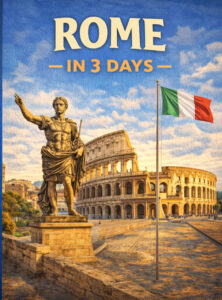
Buttons:
- Buy the Ebook Guide
- Download Sample
What’s Inside This Guide
This travel guide includes a detailed itinerary for exploring Rome efficiently, with walking routes, travel tips, and the most important attractions.
Highlights:
- Complete 3-day Rome itinerary
- Walking routes and maps
- Insider travel tips
- Restaurant recommendations
- Hidden attractions
- Practical travel advice
Although Rome is a large city, many of its most famous landmarks are located within walking distance in the historic center.
Suggested 3-Day Itinerary
Day 1 – Historic Highlights
Begin your exploration at the iconic Colosseum, the largest amphitheater built during the Roman Empire. Completed in AD 80, this impressive structure once hosted gladiator contests, public spectacles, and dramatic performances for tens of thousands of spectators.
Nearby you will find the remarkable ruins of the Roman Forum, which served as the political, religious, and commercial center of ancient Rome. Walking through the ruins allows visitors to imagine life during the height of the Roman Empire.
Continue toward Palatine Hill, one of the seven hills of Rome and traditionally considered the birthplace of the city. The hill offers spectacular views of the Roman Forum and contains the remains of ancient imperial palaces.
Next walk toward Piazza Venezia, a busy square dominated by the impressive Vittoriano Monument, also known as the Altar of the Fatherland.
From here stroll through the historic streets toward the famous Trevi Fountain, one of the most beautiful Baroque fountains in the world. According to tradition, tossing a coin into the fountain ensures that you will return to Rome.
Continue walking to the elegant Spanish Steps, a popular gathering place surrounded by boutiques and cafés.
End your first day with dinner in the historic center while enjoying traditional Roman dishes such as carbonara, cacio e pepe, or amatriciana pasta.
Day 2 – Culture & Museums
Your second day focuses on Rome’s extraordinary museums and religious landmarks.
Start your morning in Vatican City, home to the Pope and the spiritual center of the Catholic Church.
Begin at the impressive St. Peter’s Basilica, one of the largest and most important churches in the world. The basilica’s interior features magnificent sculptures and artworks, including Michelangelo’s Pietà.
Visitors can also climb the dome for spectacular views across Rome.
Next explore the Vatican Museums, which contain one of the world’s most important art collections. The highlight of the museums is the breathtaking Sistine Chapel, where Michelangelo painted his famous ceiling frescoes.
In the afternoon walk along the scenic Tiber River toward the historic Castel Sant’Angelo, a fortress originally built as a mausoleum for the Roman emperor Hadrian.
Later cross the beautiful Ponte Sant’Angelo, a bridge decorated with statues of angels, and return to the historic center.
Spend your evening in the charming Trastevere district, one of Rome’s most atmospheric neighborhoods known for its narrow streets, lively piazzas, and traditional restaurants.
Day 3 – Neighborhoods & Local Life
Your final day focuses on exploring Rome’s neighborhoods and experiencing everyday Italian life.
Start your morning at the lively Campo de’ Fiori Market, where local vendors sell fresh produce, flowers, and regional foods.
Next visit the nearby Pantheon, one of the best-preserved buildings from ancient Rome. Built nearly two thousand years ago, the Pantheon’s enormous dome remains an architectural masterpiece.
Continue walking toward Piazza Navona, one of Rome’s most beautiful squares. The square features elegant fountains, cafés, and the famous Fountain of the Four Rivers designed by Bernini.
In the afternoon explore the peaceful Villa Borghese Gardens, one of the largest parks in Rome. The park contains museums, scenic paths, and beautiful viewpoints overlooking the city.
Within the park you can also visit the Borghese Gallery, which houses masterpieces by artists such as Bernini, Caravaggio, and Raphael.
Finish your Rome trip with dinner at a traditional Roman trattoria while enjoying Italian wine and local specialties.
Explore the City Map
Insert a map showing the main attractions and walking routes.
Examples:
Day 1 walking route
Colosseum → Roman Forum → Palatine Hill → Trevi Fountain → Spanish Steps
Day 2 museum district
Vatican Museums → St. Peter’s Basilica → Castel Sant’Angelo → Trastevere
Day 3 neighborhood exploration
Campo de’ Fiori → Pantheon → Piazza Navona → Villa Borghese
Rome’s metro and bus network make it easy to travel across the city.
Why Visit Rome
Rome offers a fascinating mix of culture, architecture, and local lifestyle. Visitors can experience historic landmarks, lively neighborhoods, and excellent Italian food within a city that feels like a living museum.
Reasons to visit Rome include:
- Ancient Roman monuments and ruins
- Magnificent churches and Vatican landmarks
- Beautiful historic squares and fountains
- World-famous Italian cuisine
- A vibrant and lively atmosphere
Rome’s incredible history and timeless charm make it one of the most unforgettable destinations in Europe.
Who This Guide Is For
Ideal for:
- First-time visitors
- Weekend travelers
- Independent explorers
- Travelers who enjoy walking itineraries
- Visitors with limited time
Get the Complete Rome Guide
Download the full guide to access the complete itinerary, detailed maps and practical travel advice.
Buttons:
- Buy PDF Guide
- Buy Print Guide
- Preview Sample Pages
More City Guides
You may also enjoy:
- Paris City Guide
- Barcelona City Guide
- Vienna City Guide
- Prague City Guide
Frequently Asked Questions
How many days do you need in Rome?
2–3 days is enough to see many of the major landmarks, although longer stays allow deeper exploration.
What is the best time to visit Rome?
Spring and autumn offer pleasant temperatures and fewer crowds.
Is Rome walkable for tourists?
Yes. Many of the main attractions are located within the historic center.