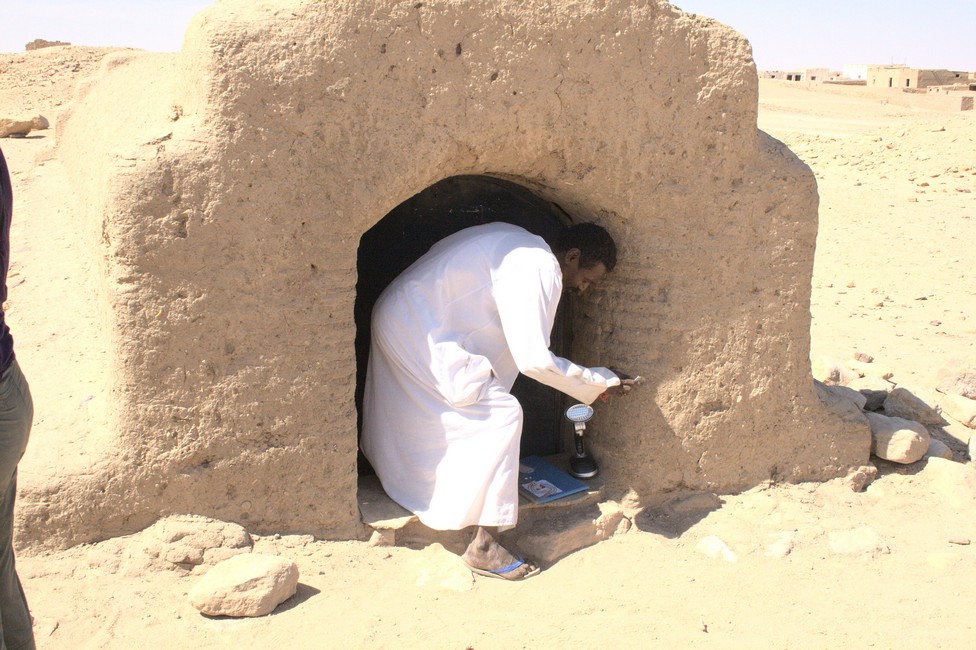
With Hassan, we visit Khartoum sights and first drive to Omdurman to the Tomb of the Mahdi.
Karthoum Sights – Street Cafe
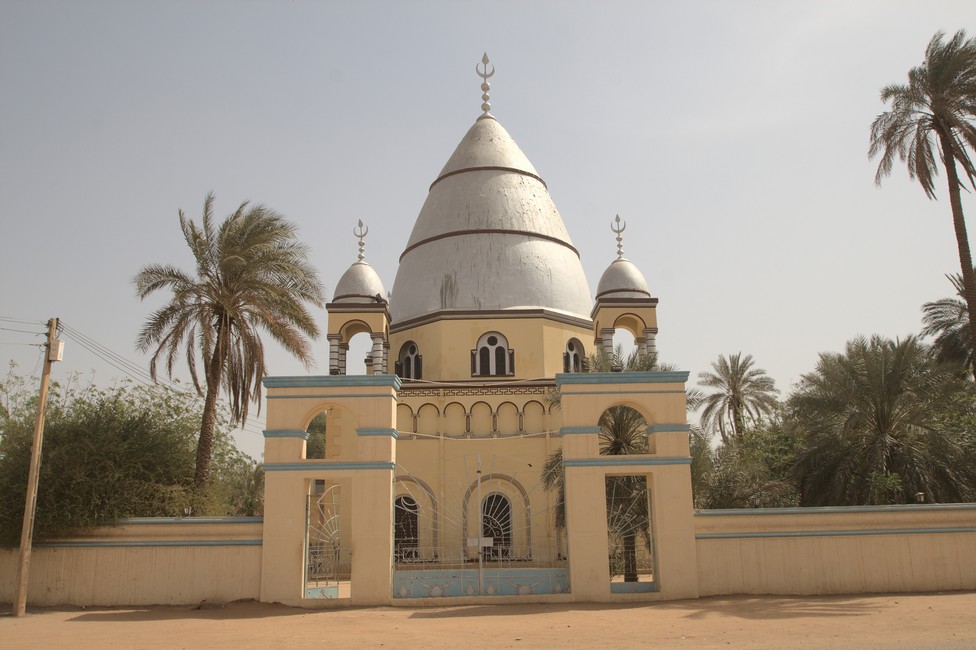
Just five months after his victory over Khartoum, the Mahdi died after a brief illness in 1885. The tomb with a silver dome was built to honor him. It became a real pilgrimage for all Sudanese, which replaces the pilgrimage to Mecca. After the British had recaptured Khartoum, they blew up the monument in the air to destroy the pilgrimage. The nephew of General Gordon did the job, and scattered the ashes of the Mahdi in the Nile. Lord Kitchener wanted the head of the Mahdi as a pencil stand, however, took distance from this, now the head is buried in Wadi Halfa. An exact replica of the tomb was built in 1947 again.
The tomb can be entered by non-Muslims, but women must cover their hair.
Karthoum sights – Tomb of the Mahdi
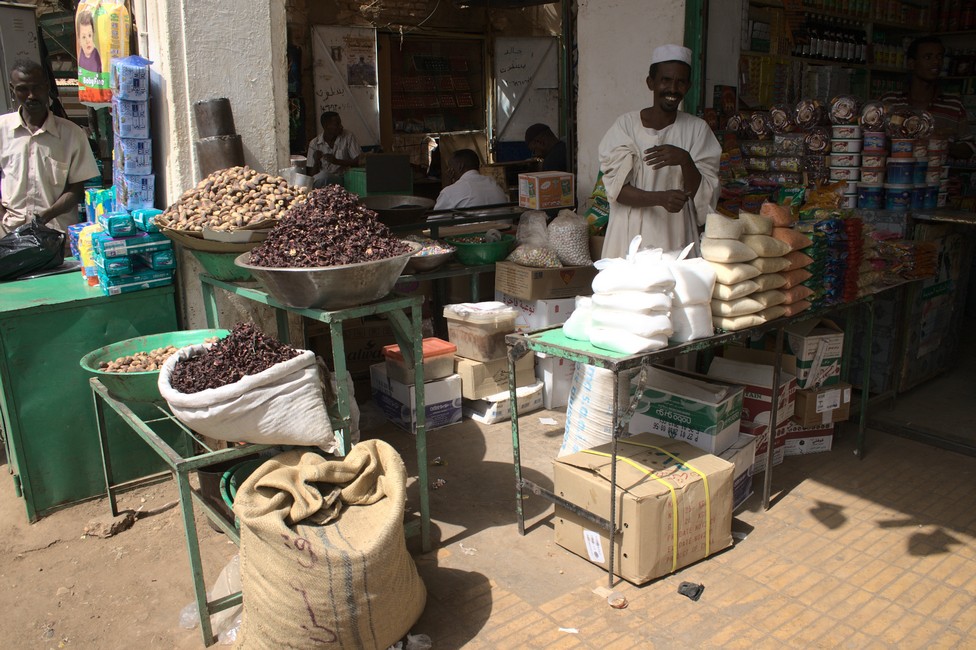
Hassan drives us to the souk of Omdurman. He is waiting in the taxi. The souk is the largest in the Sudan. The main section consists of many narrow streets with shops and stalls. The buildings are very old, but the sounds, the smell and the different dialects make up the charm of the souks.
We stroll relaxed through the streets, as Khartoum is regarded as the safest capital in Africa. The people are very friendly here, they of course want to sell something.
Market
On a corner shoes are offered ,at a different corner spices. All this is available in the souk. There are not only crowds of people in the bazaar, but also traffic jam. Motor rickshaws fight with cars to the right of way. A really lively mess.
With Hassan’s taxi we torture ourselves out through heavy traffic to the periphery, where there should be a camel market.
The traffic is unusual by Western standards and we are glad that we have left our car in the Blue Nile Sailing Club, our camping site.
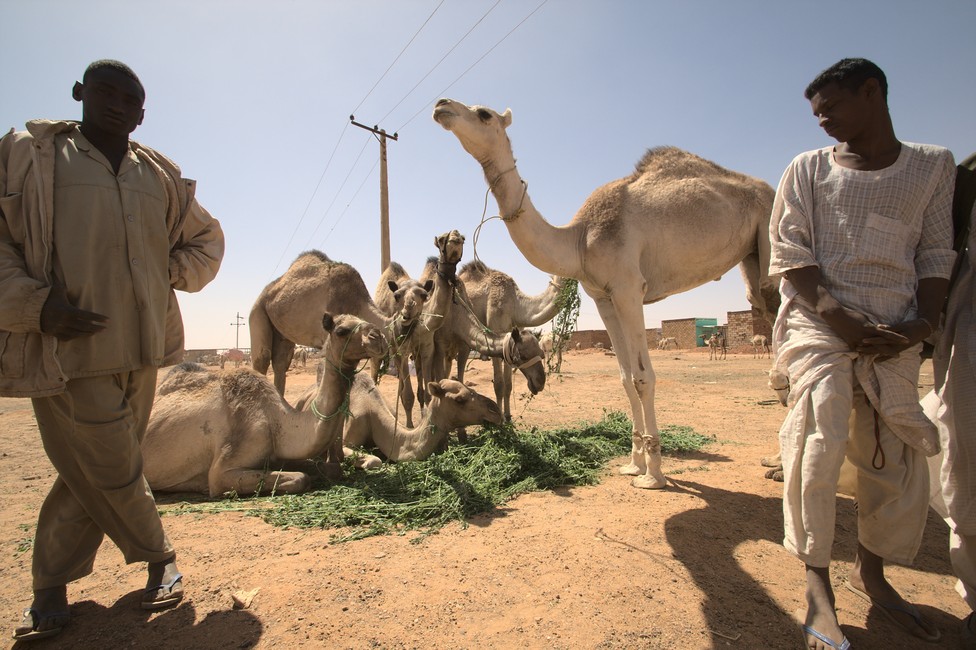
The camel market does not meet our expectations. It is said to be the largest in Sudan, but we see only a handful of animals. The province of Darfur is the center of camel breeding in the Sudan and most of the animals that are offered for sale, comes from this region. Most camels are destined for the Egyptian market as meat suppliers, a small portion is delivered to the Gulf states as racing camels.
Camel Market
We talk to a group of traders. Hassan translates. Of course, we are an attraction here when do Europeans come to the camel market. Our women are naturally admired. Timid, cautious approach to a foreign culture. Proudly they show us the animals. Normally you have to pay the bride price for marriage in camels. But we do not get an offer. We do not know whether these animals have already been sold, or whether a buyer is sought.
The camels like the fresh green grass. We take photos and they want money, for food of course. We make a donation and leave.
In the afternoon the next day we are already in Khartoum, the capital of Sudan. There are quite a lot of interesting sights in the City. Khartoum was founded on the confluence of the White and Blue Nile, and actually consists of three parts. The historic center, Omdurman, the old capital of Mahdi and the modern Khartoum North.
The strategic importance of the confluence of the Blue and White Nile for the first time recognized Muhammad Ali in his expedition to the Sudan1820. The original main market in the region was then transferred from Shendi to Khartoum and a garrison was established here, which eventually became a permanent settlement. Prior to that time it was not more than a fishing village. Only 10 years after the expedition Khartoum grew enormously. The city experienced a boom from 1850 as the Nile was released for the ships into the South, and the city became the main transit point for ivory and slaves.
The pressure of the Europeans in Khartoum led to the closure of the slave market 1854. Thus the Nile became less important for Khartoum.
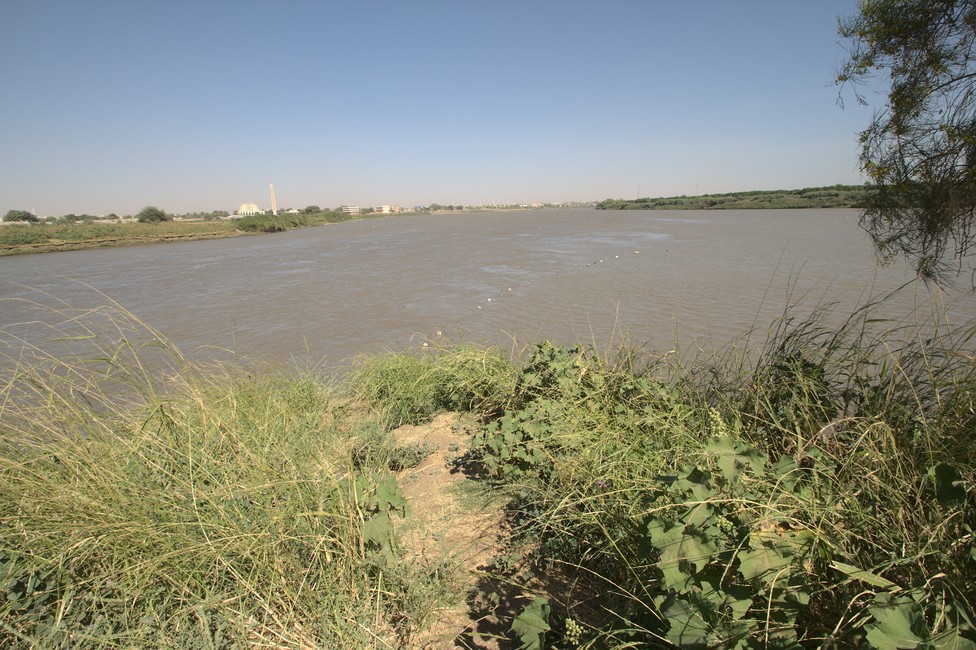
A good view of the confluence of the Nile is from the Mogran Family Park
Karthoum – confluence of white and blue Nile
Good to see also the unusual hotel Burj Al Fateh Hotel is, built in the form of a sail. We hear it should belong to the Libyan leader Gaddafi, or he should at least be involved by funding.
Karthoum – Hassan our Guide
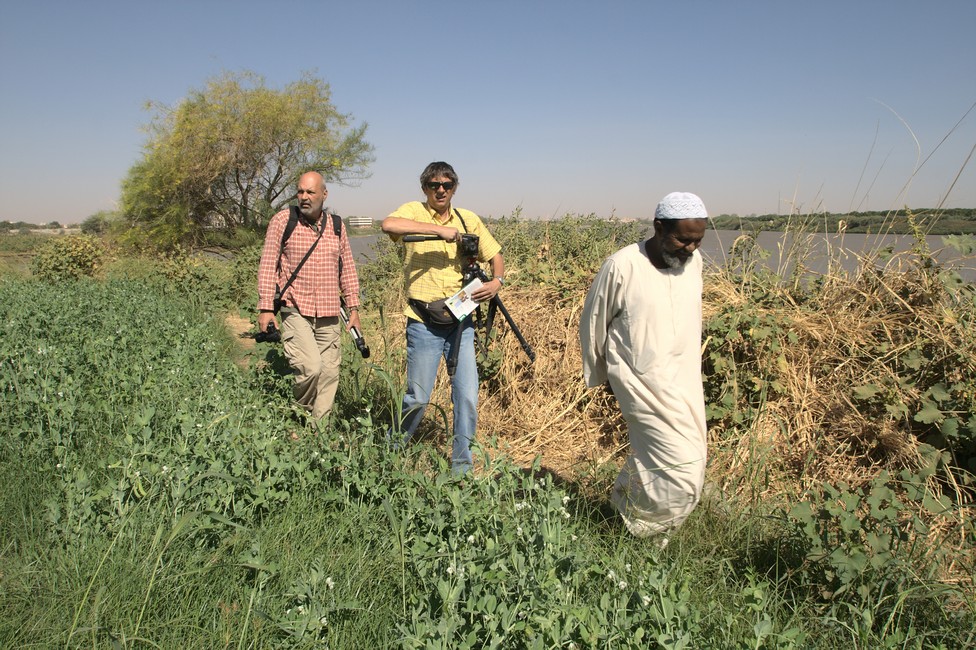
At the campsite we meet the taxi driver Hassan, he will show us Khartoum the next day. Hassan is fluent in German, he tells us that he had worked for years in Germany as a truck driver, but the homesickness drew him back to Sudan. From the savings he bought a car that is by now 25 years old with which he earns a living as a taxi driver.
The Merowe Pyramids are on the agenda. From Karima we head towards Atbara. We need to crossBayuda desert. This is not a big challenge, because it is tarmac up to Atbara. However, it is very hot, even the wind does not cool.
The Bayuda desert is a part of the Nubian desert and lies in a bow formed by the Nile. In the South it gradually goes over into a sparsely vegetated landscape, which extends to Khartoum. It consists predominantly of a mixture of sand and stones, and is interrupted by occasional long covered ridge. In the wadis grow woody shrubs, low trees and a bushy acacia.
We have a break, because the heat is tremendous. Imposing are the ridges that extend through the endless desert. Occasionally bushy acacia come out from the sand, one wonders where this bush gets the water from. The settlement is very sparse, mostly nomads with their camels live here.
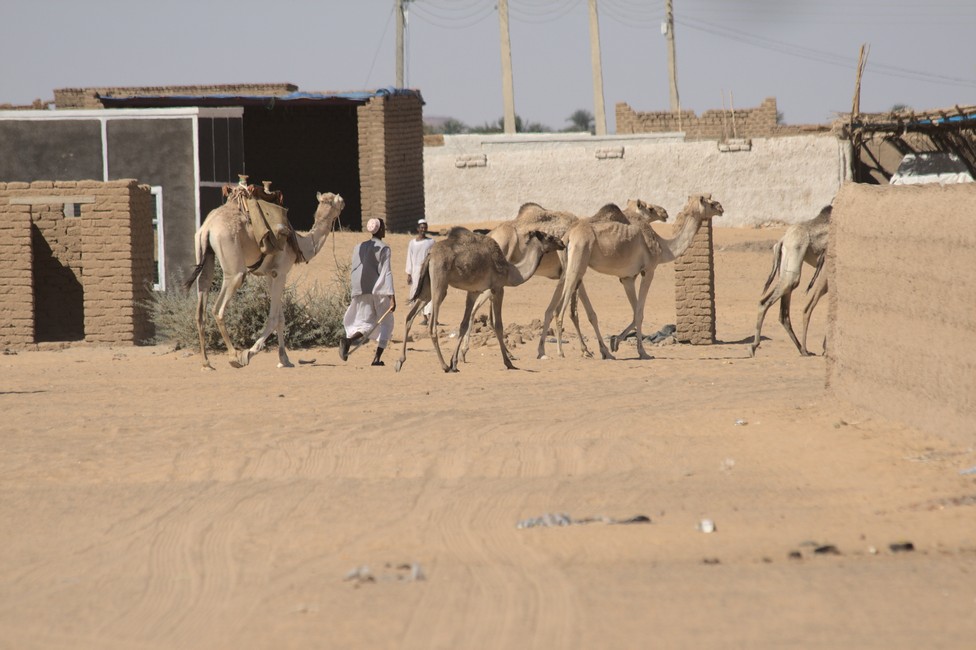
At our resting place a nomad passes with his animals in the distance. We wave, the greeting is answered, then he moves on, probably to Atbara on the market, perhaps he wishes to sell camels.
Because of the great heat, we decide to finish early today and find a good place for the night. We use the afternoon to relax and hide in the shadows of our vehicles.
On a new bridge we cross the Nile direction Atbara. The road is good and we are making rapid progress. We look out for a coffee woman, we want some breakfast.
Street food near Atbara
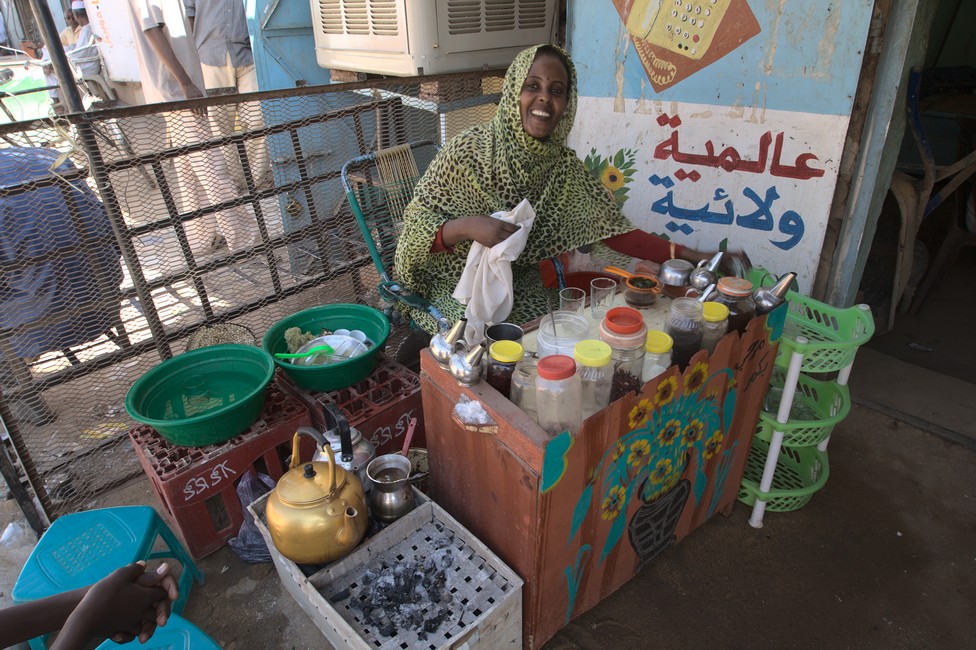
In Atbara, there is nothing to see, it is a transportation knot for the rail, a typical city with low houses and bustling activity. We do without a visit and stay at the roadside stand at a coffee woman.
We learn that the lady is not Sudanese, but an Ethiopian, probably a Somali.
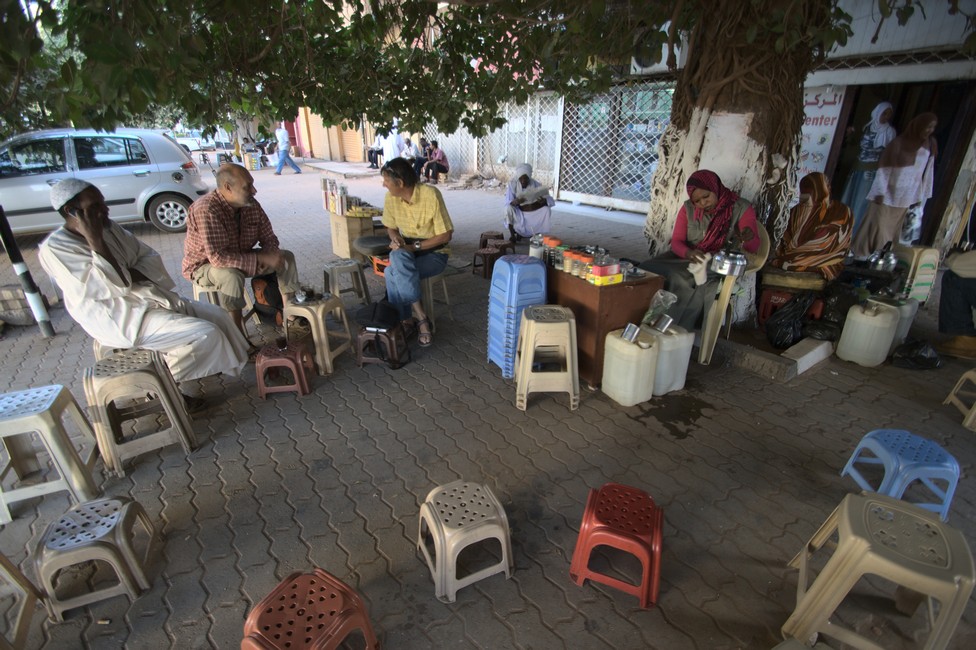
Coffee in the streets
Since the war, many Somalis are living in Sudan, especially in the capital Khartoum. The coffee preparation is interesting. Not only coffee but also spices are mixed into the coffee. Each woman has her own coffee recipe and the drink tastes delicious.
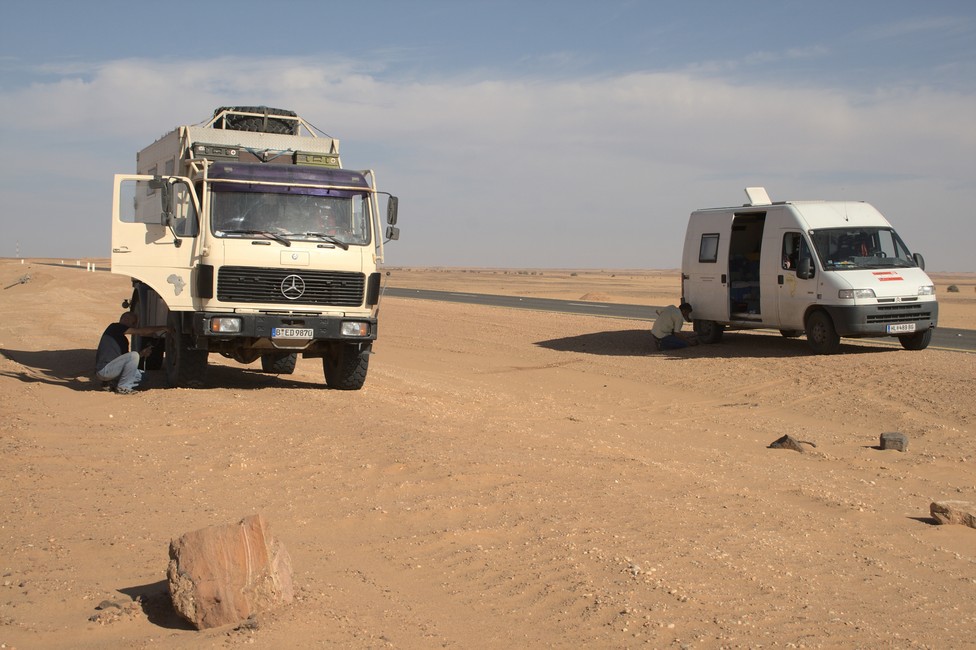
After this break we go to the Merowe pyramids. Good asphalt road and we make it to the late afternoon to the pyramids. We turn from asphalt towards the campsite and again we are stuck in the sand. Now, air must be released to about 1.5 bar to move forward again, sand ladders, we will not need.
Tara feels hot, she’s bored and doubts in my car driving skills. It does not help, now we are waiting in the sweltering heat until all the tires are ready. The scenery all around us is spectacular, like a picture book, lonely and abandoned. Not quite as lonely, camel riders are approaching from the distance. Tara can not stand this and barks at the strangers. Her job is to guard the car after all. We do not know what the riders want from us. Language barriers. But it quickly becomes clear. They want to take Alexandra for a ride in the desert. The camel protests, it would rather lie in the shade, but it does no good, on its feet and off they go.
And before I realized what happened, my wife has gone already. I can not worry about that now, I must release air from the tires to get the car go again. After a while Alexandra is brought back, she liked it well, no one asked me.
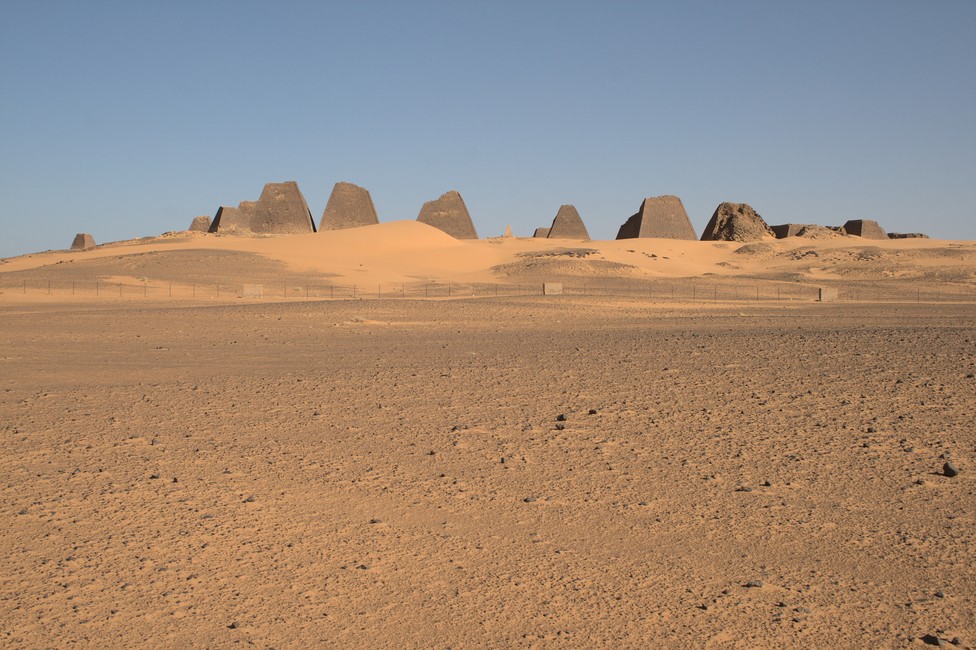
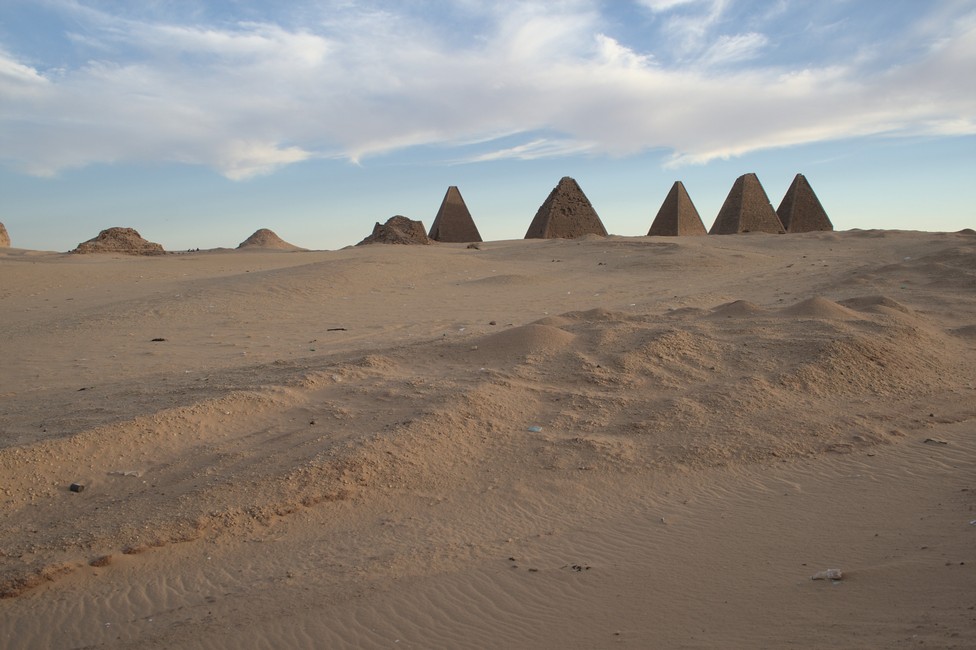
Now we can start again. The Pyramids of Merowe are located in a beautiful landscape. They are the main attraction in the Sudan in cultural terms, even though you feel nothing of tourism here, for it is still in its infancy.
Merowe Pyramids
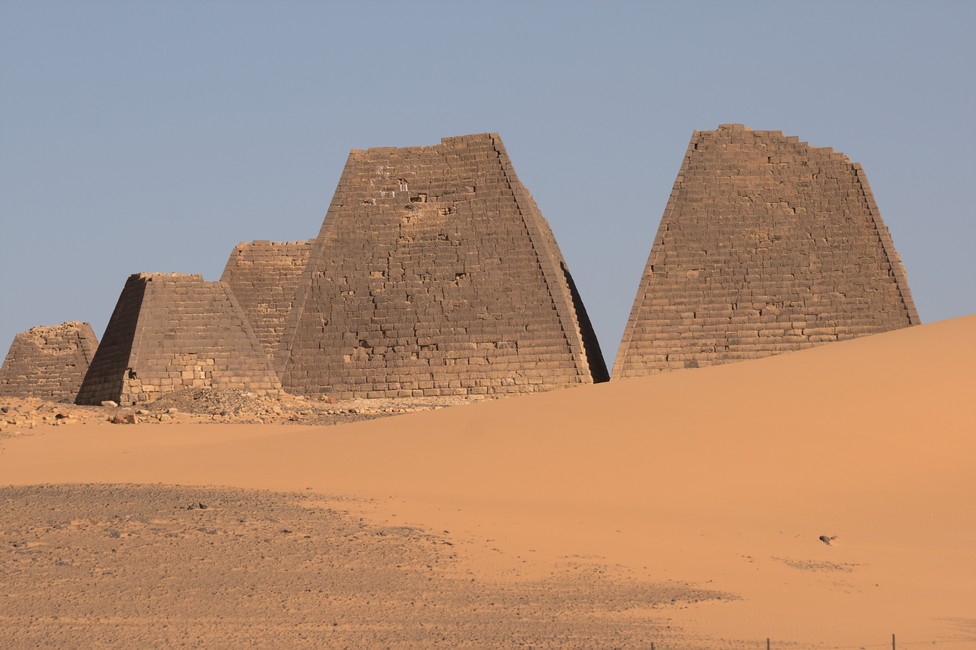
The pyramids stand alone on a hill like a row of broken teeth. An interesting sight.
Merowe Pyramids
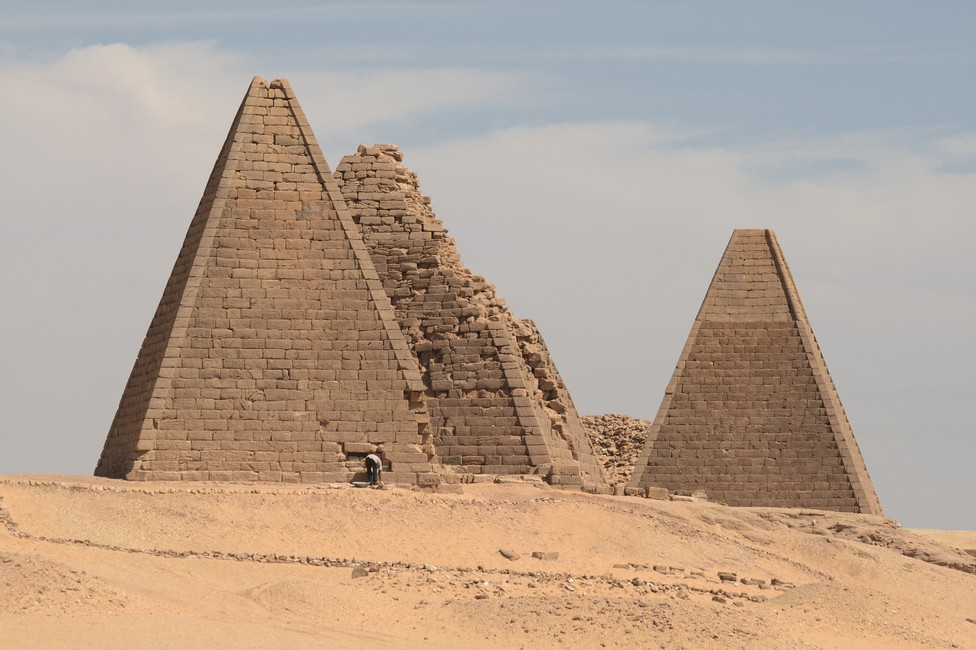
Though the pyramids were clearly influenced by the Egyptian counterparts, they are however very different in shape and size to those at Giza. The largest of the pyramids of Meroe or Merowe as it is written, is under 30 meters with an angle of 70 degrees. The smaller size allows for quicker construction time and fewer workers, including the technical costs were less. The grave chambers were directly cut into the rock and the pyramids just built on top of it, a substantial difference to those in Egypt.
The pyramids were covered with a clay plaster, giving them a smooth, shiny surface. The base was simply painted in red, yellow and blue stars.
Unfortunately, all were beheaded, which is due to the work of an Italian treasure hunter.
We cast a last glance at the magnificent scenery before we torture our vehicle through deep sand to the campsite. The difficulty is to find the right track. We can see the campsite in the distance and head towards it. Sections with firmer sand alternate with soft sand. One must realize in time when it is soft, so you have enough momentum on the one hand, on the other hand, enough torque in reserve. Despite the 125 horsepower, the engine works heavily. However, we are also quite loaded with diesel and water reserve, an additional weight of 150 kilograms.
We did it without getting stuck. Now we are at the campsite and have a fantastic view of the desert.
Campsite at the Pyramids
In the distance, one can again see the Merowe pyramids. No wonder why the rulers have chosen this place as the final resting place.
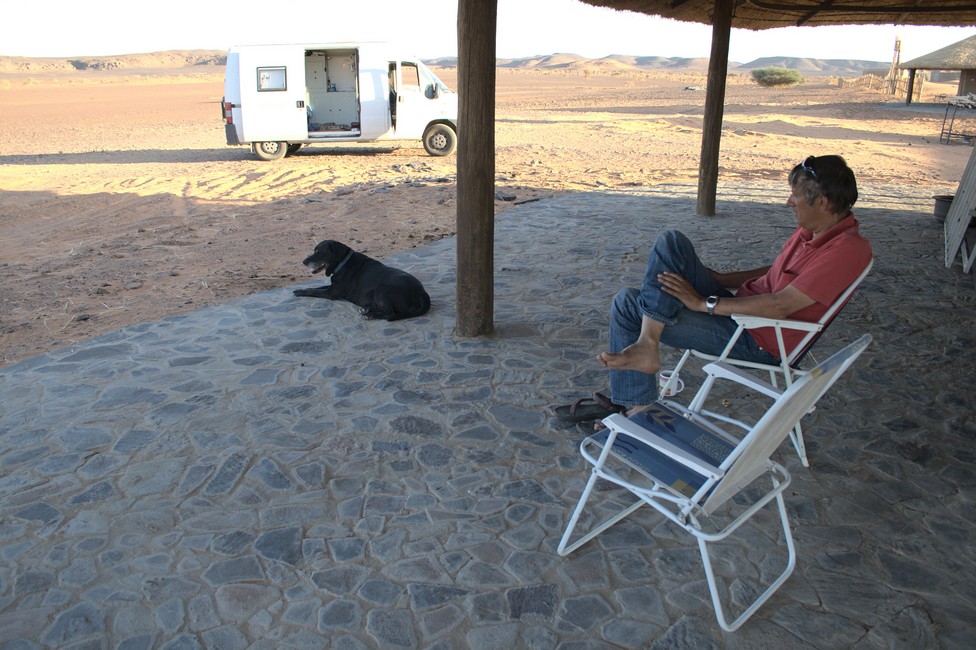
We were lucky again and found a great place to stay overlooking the Pyramids. We enjoy the rest of the afternoon with a bottle of cold beer. Tara is also satisfied , she can easily explore the area and enjoy her evening walk.
In the afternoon the next day we are already in Khartoum, the capital of Sudan.
Camel herds are a daily appearance in the Sudan. A herd crosses road, we must wait. Camels have right of way. One is well advised to let pass animals, no matter which, because they are not used to traffic and can not assess the risk of a vehicle.
Camels
The gravel ends here and we have to continue on tarmac, because we want to get to Karima before sunset. On the tarmac, we are progressing quickly, there are 120 kilometres to the pyramids of Karima.
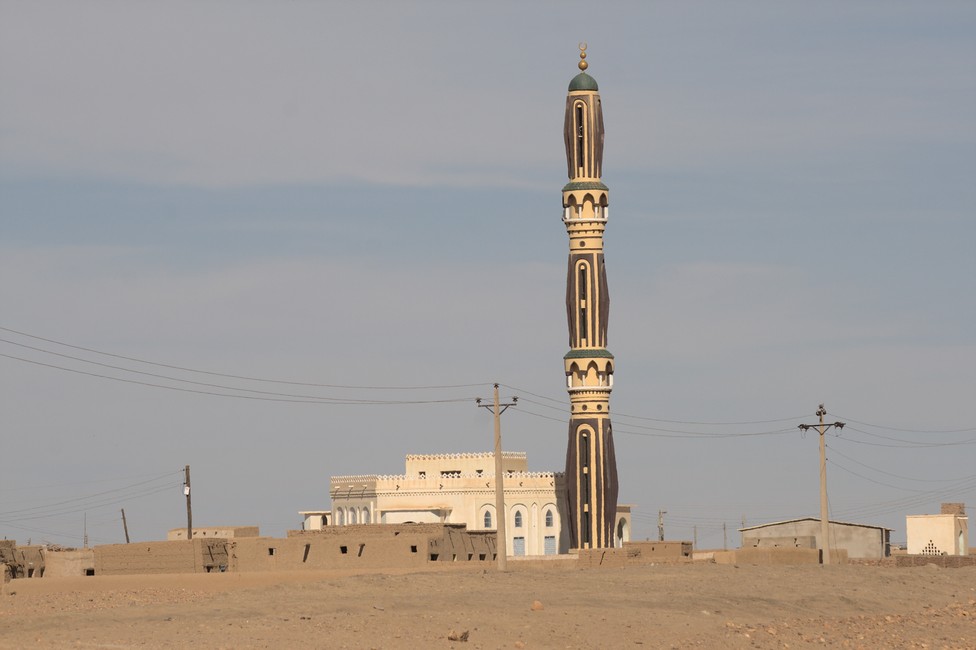
Along the way again and again slender minarets rise from the plain. This is unusual and fascinates us, not only the form and method of construction is unusual, but also the paint.
Sudanese Mosque
Shortly before Karima we turn off the main road and then along the Nile in search of an overnight stay. This time, it is difficult, because this bank is very densely populated.
We must still do shopping,in the village shop Alexandra and Bine have not got everything. A quick stop and wait, the ladies go shopping. During the waiting time I observe the village life.
We wander around a bit and can not find a suitable campsite for the night and it’s getting late. There are days while travelling when nothing works out right, and usually something happens. Today is one of those days.
We must continue to Karima, in the evening light we pass Jebel Barkal, the sacred mountain and can also take a look at the pyramids, we want to visit tomorrow, but now we turnoff in half-dark into the desert. I follow Bodo’s truck and the inevitable happens, we get stuck in the sand and have to liberate us in the dark yet.
Only next morning, we can see how badly we were stuck.
In the pitch dark, we had to shovel both cars free and release air, at least to get on solid ground. Now we are left with half-filled tires, it doesn’t matter to Tara, she seeks shade because it is pretty hot early in the morning. Now it’s time to fill air in the tires, because we will drive on tarmac.
Refilling the tyres
Our mini compressor is existing, thanks to the care of my wife. Originally we did not want to buy any because we were traveling in a group where there were large powerful compressors. But my wife saw this little thing and insisted on buying it. I was skeptical, but now we are glad we have it, for it is often being used, and makes us well, even in the depths of Africa, we will need it often, not only in the desert.
And surprisingly, it works quite well too. For 30 € a bargain. Bodo is also filling hir tires. The truck has air brakes and it automatically has a compressor on board. After the tires are warmed up, I check again and correct the pressure bar to the required 4.5.
In a short time we are at the Pyramids of Karima. It is a site of about 20 pyramids on the west side of the Jebel Barkal, the holy mountain. They are built differently than the pyramids in Egypt, they are built much smaller and steeper. They are clad with sandstone.
Pyramids of Karima
It is a large site, which consisted of the pyramids and some temples, but from the temples hardly anything is left.
Pyramids of Karima
Nevertheless, the whole area is shrouded in a mystic atmosphere.
A few kilometers further we visit the royal cemetery at El Kurru, a World Heritage Site. We must find the supervisor that unlocks the graves.
El Kurru
The graves have no light, so we help ourselves with our torch. Great wall paintings come to light, we are impressed by the good state of preservation and the mystical mood of these graves.
Next morning we continue along the Nile in rural Sudan. We want to the Pyramids of Karima. We do not take, however, the route through the desert from Dongola, but travel on along the Nile.
Although the villages along the Nile are very small, each has a mosque and sometimes quite large. Sudan is 70% Muslim, Sunnis in particular. Islam came to Sudan as the Arabs expanded their spheres of influence, after the death of Muhammad in seventh Century. Here in the main settlement area of the Nubians the Islamization happened 600 years after the death of the Prophet, because the Nubians were originally Christians.
Rural Sudan
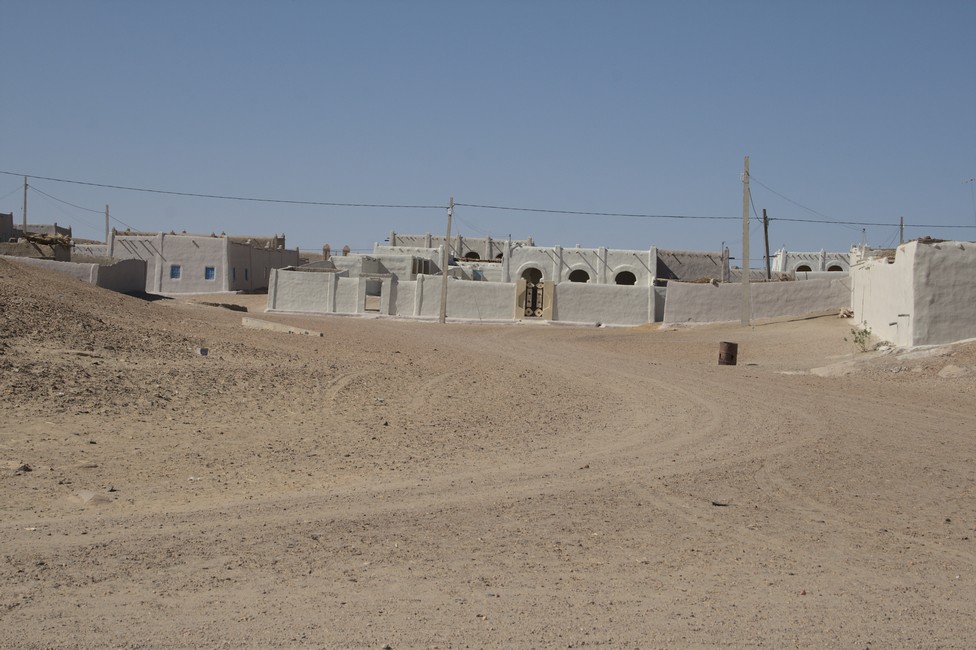
We stop in a village to take a closer look at the houses around us. Here’s a brick house out of clay, there’s always a wall decorated with beautiful entrance gate. The houses, as well as the walls are painted, often white-washed, sometimes decorated with patterns.
Striking is that no people are on the street, but not surprising, because at noon it has well over 40 degrees in the shade and so the people spend their time in the cool courtyards of their buildings and properties.
A special feature is the small brick water or well houses that can be found in front of many houses. There are always water jugs inside ready, which are also available to the passing stranger.
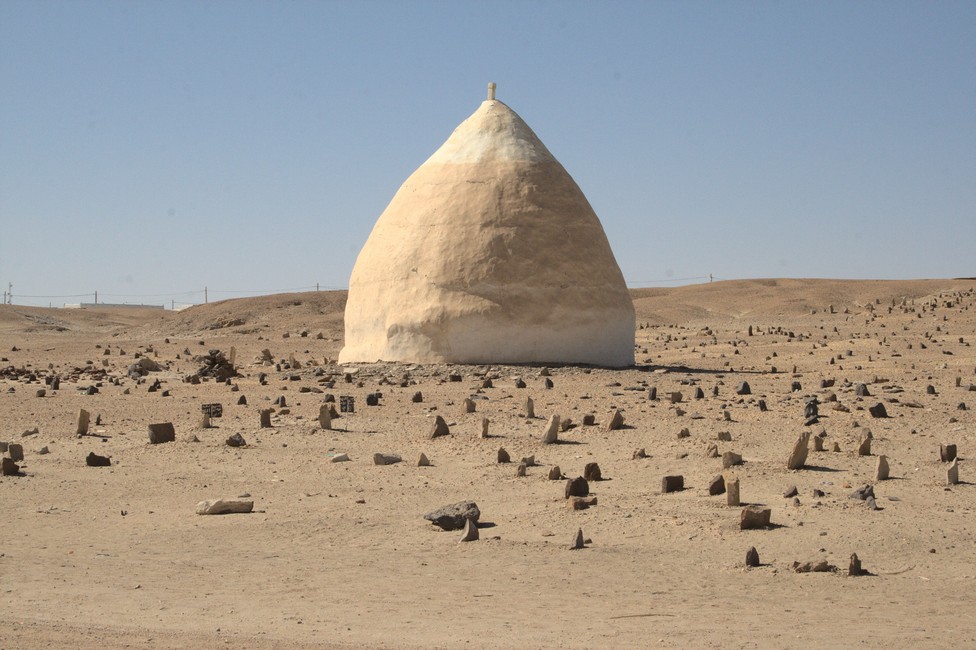
Sudanese cemeteries are always just outside a settlement, the graves are marked only with a stone. Slogans such as name or date of death are missing.
Cemetery with tomb stones
The Islamization process was a slow one, since the Arabs held on to their nomadic traditions and originally had no interest to Islamise other areas. Islam was brought in the Sudan by some holy men. Only in the 16th century there was a kind of islamisation established by the Funj kingdom. The Funj were Muslim rulers, which brought stability and attracted missionaries from Cairo and Baghdad. Among them were the Sufis, a new group, which also play an increasingly important role in the Sudan.
Reminded by the green fields of vegetables, we want to shop for dinner. We need eggs and vegetables that we buy in a small shop in a village.
The shop offers the bare essentials, we get eggs and vegetables, as usual communication is difficult in remote areas. Whether here a stranger has ever shopped once is uncertain.
The men are friendly, but confused, with such frequent occurrence of women.
In the early hours of the morning we set off towards Dongola. We again take the gravel road that runs along the Nile to see the pretty villages.
The track is pretty good, quite soft, because the ground is sandy. In addition, the route was held recently repaired. Dirt roads quite often need repairs, for the weather, like wind or rain in the South, which damages the roads often heavily. If a vehicle is stuck, it leaves a hole, in which other cars stuck again. Thus, a dirt road after a short time gets into a rollercoaster road that must be repaired from time to time with heavy machinery.
Sign posts are missing and it is often difficult to find your way. As long as we drive through towns, it is relatively easy, outside villages branch different tracks and we are often unsure which one to take. The navigation system helps, it shows the direction. Since the traffic volume is low and mainly consists of local traffic, signs are not necessary, anyway, the locals know the way and foreigners come here rarely.
After some time we are back on tarmac, we need to cross a bridge to the other bank of the Nile to reach Dongola. The bridge is only a few years old, earlier here was a ferry across the Nile.
Dongola Sudan
Travelers tell us that in 2005 all the way from Wadi Halfa to Dongola was difficult dirt road, and the that the tarmac is only a few years old, and the bridge as well.
After days of driving on gravel we are happy again to be on tarmac, although the dirt road leads through the villages and you can see just interesting things, for those who are in a hurry, the tarmac route is the faster alternative, that leads through the desert through uninhabited area.
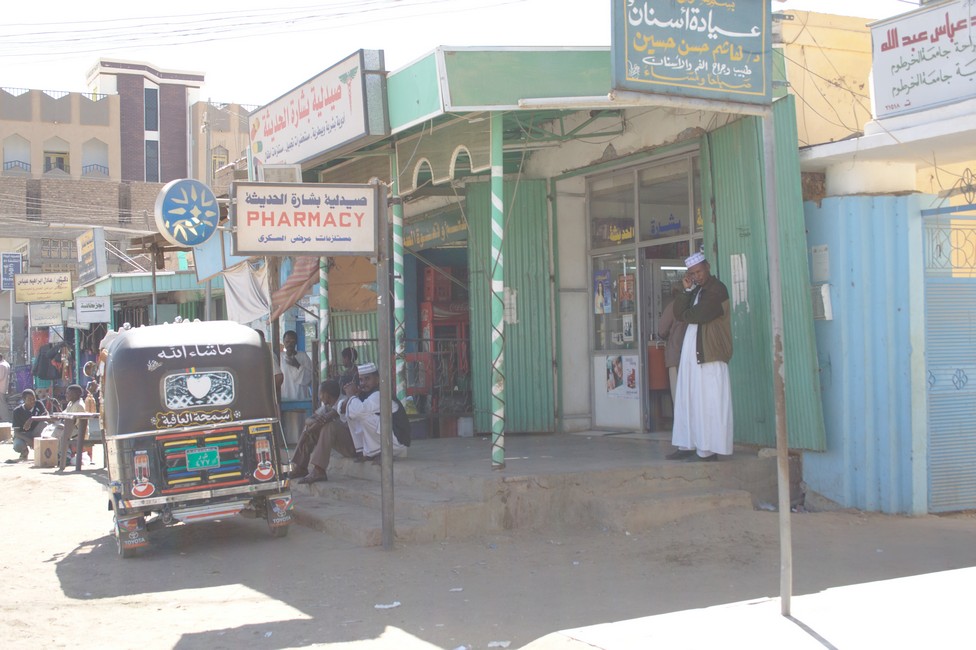
Shortly after the bridge, we reach the entrance road to Dongola. Urban public transport is done by so called Tuk Tuk, which are three-wheeled bubble cars to the sides open, with two-stroke engine. An airy kind of taxi and quite pleasant in the desert heat. The ride must be negotiated in advance, but the prices are very reasonable.
We park our vehicles on the roadside and make our way to shop.
Dongola is the capital of the Province of North Sudan, an area that measures 600 by 600 kilometers. It is also the capital of the Nubians. The city lives on agriculture. Well irrigated fields along the Nile bring crops, fruits and vegetables on the market of the city. Dates also play a big role, they are harvested during September and October.
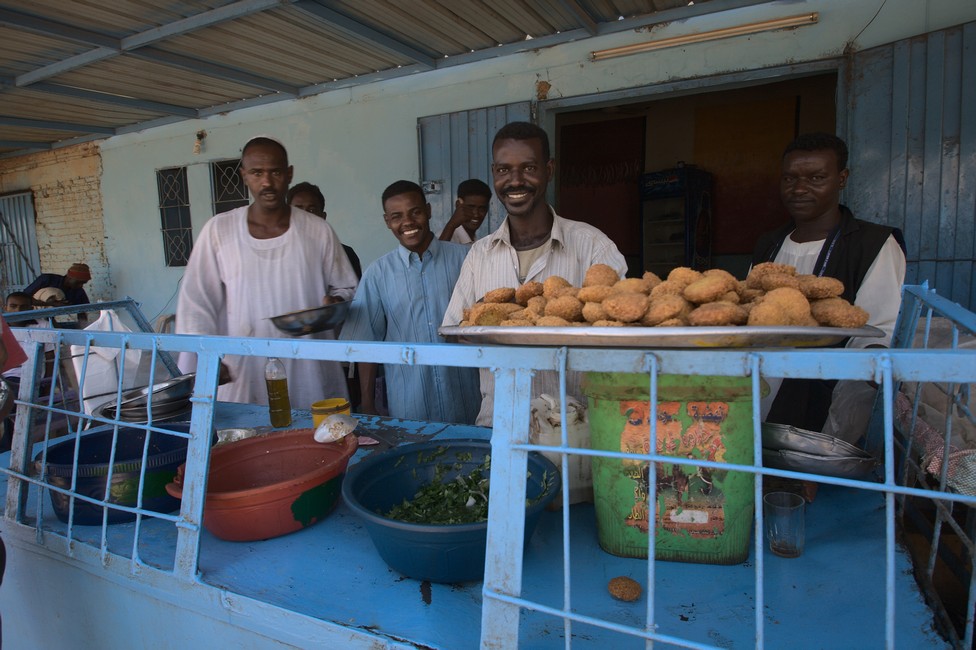
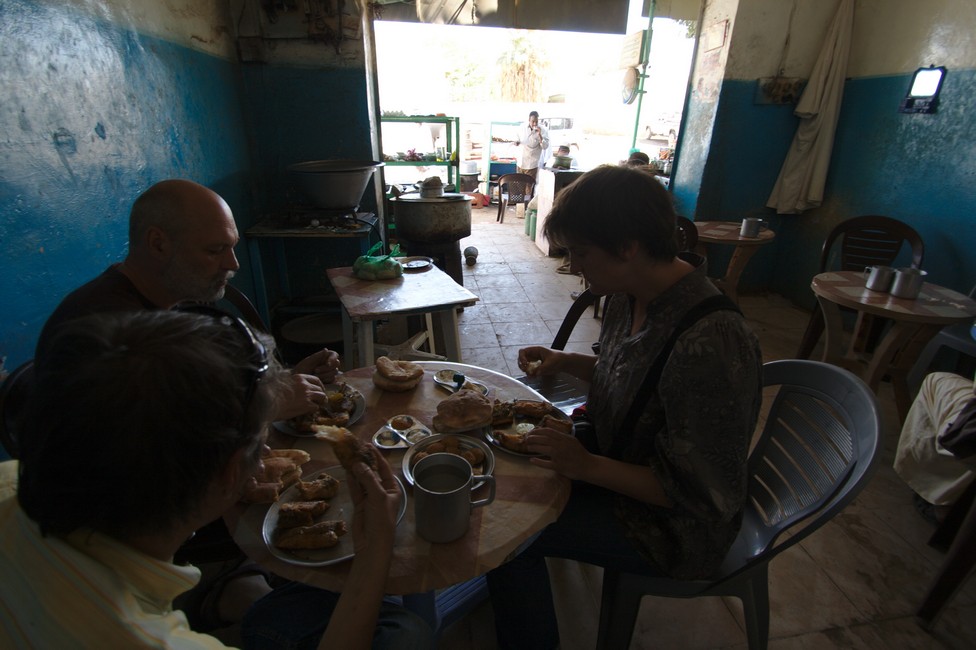
Before shopping we need to strengthen ourselves and find a roadside restaurant on the main road.
The food is delicious. There is falafel, pita bread and fried fish, probably from the Nile, I do not even want to know it as precisely, as it should be Bilharzia water, good appetite, anyway we enjoy our meal.
For drinking a metal container with water is put on the table, as usual, perhaps Nile water as well, but now it does not matter, we have already eaten the fish.
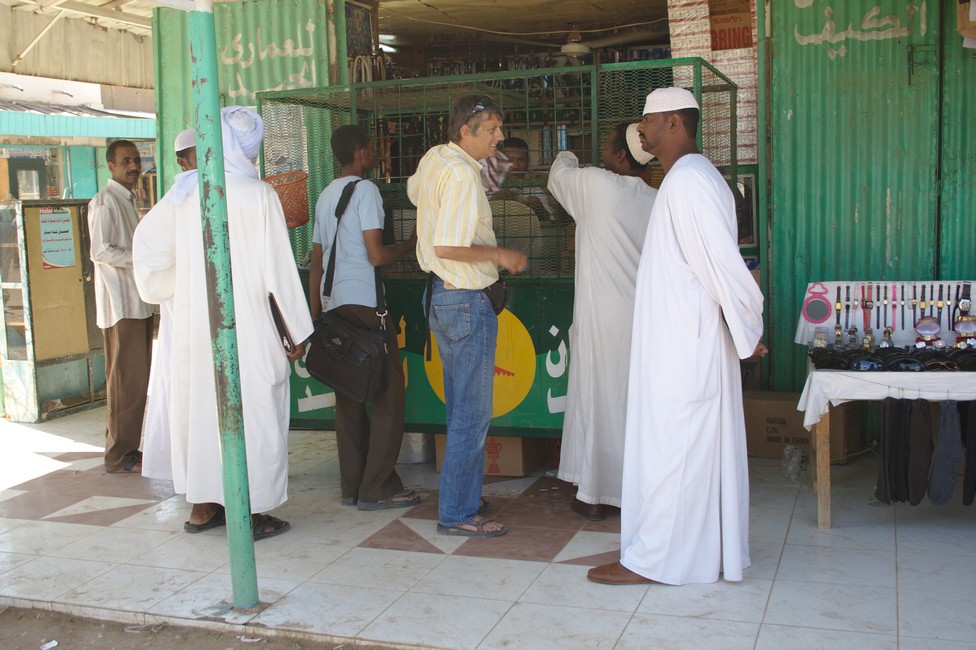
The following shopping trip becomes quite funny, we have fun with the traders, of course we take pictures, and the dealers themselves pull out a camera and take pictures of us.
Shopping in Dongola
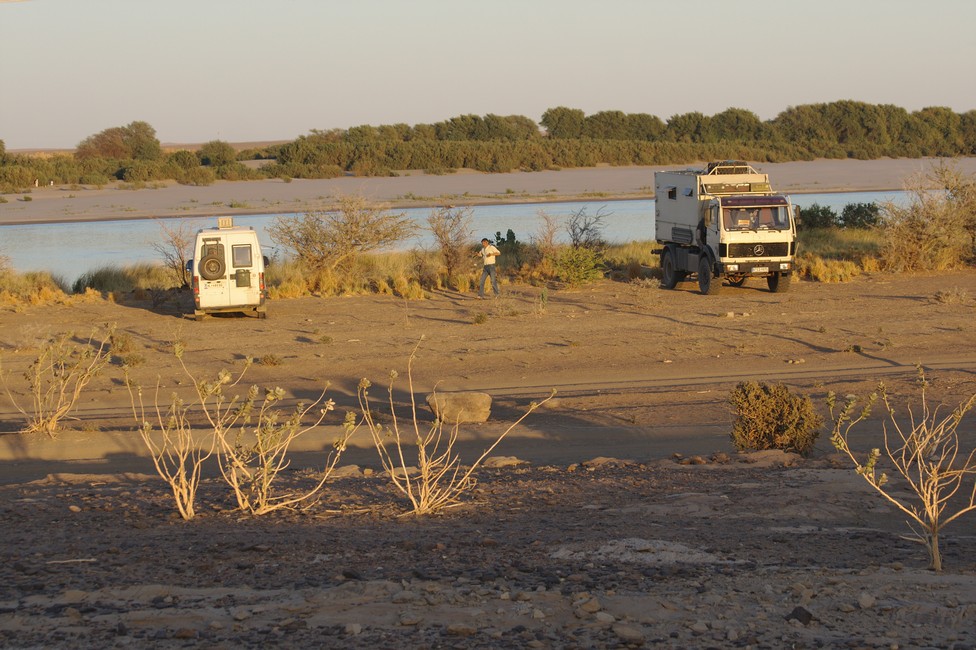
We leave Dongola south and find an idyllic place at the Nile for the following night.
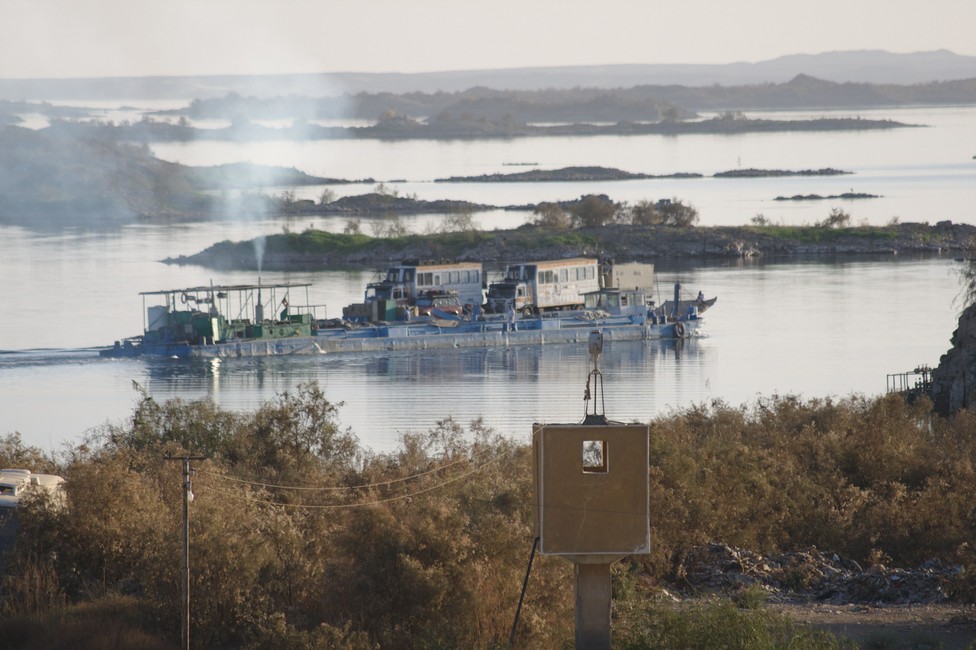
From the passenger ferry we see our vehicles on the barge including our dog Tara
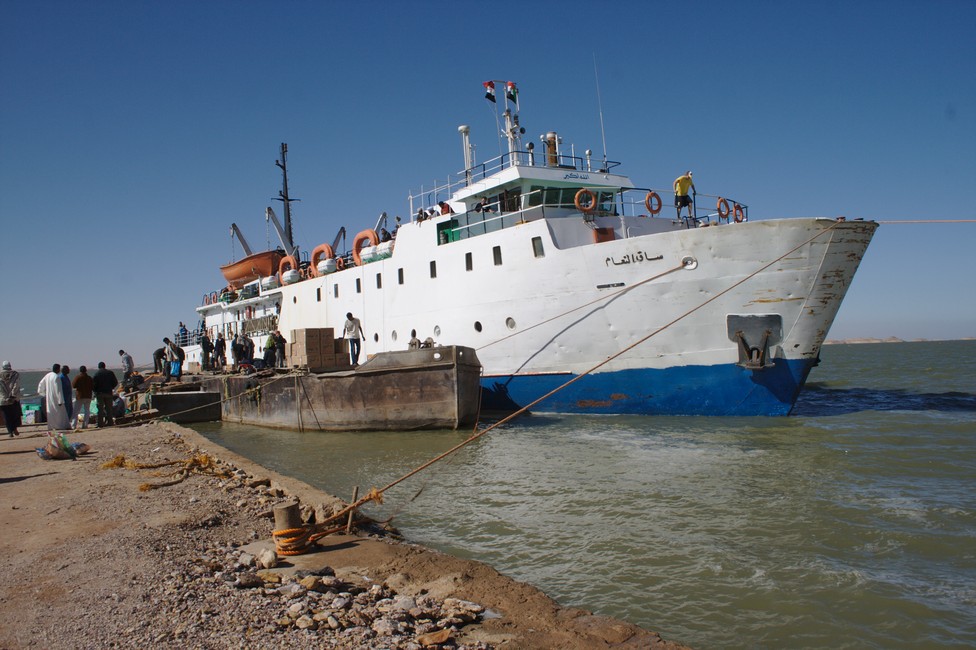
The port of Wadi Halfa, we have imagined really differently. It is only a strip of sand, in front an old body of a vessel is anchored there, our passenger ferry is fixed to it. Welcome to the Sudan.
Our ship has arrived at the harbor
The mooring is trouble free, not at least because we had a fixer again, a nice guy, we can recommend, called Mazar Mahir. We get our passports back and after about an hour, we have Sudanese ground under the feet.
To our delight, our dog has survived in quite good condition we swear to Allah we will never do that again, the captain has fed her plenty, a month’s portion and watered her properly, and she makes no impression of being stressed. The vet first wanted to examine our dog first, but when he saw her, he was thinking she is dangerous, so he just prepared the papers for her.
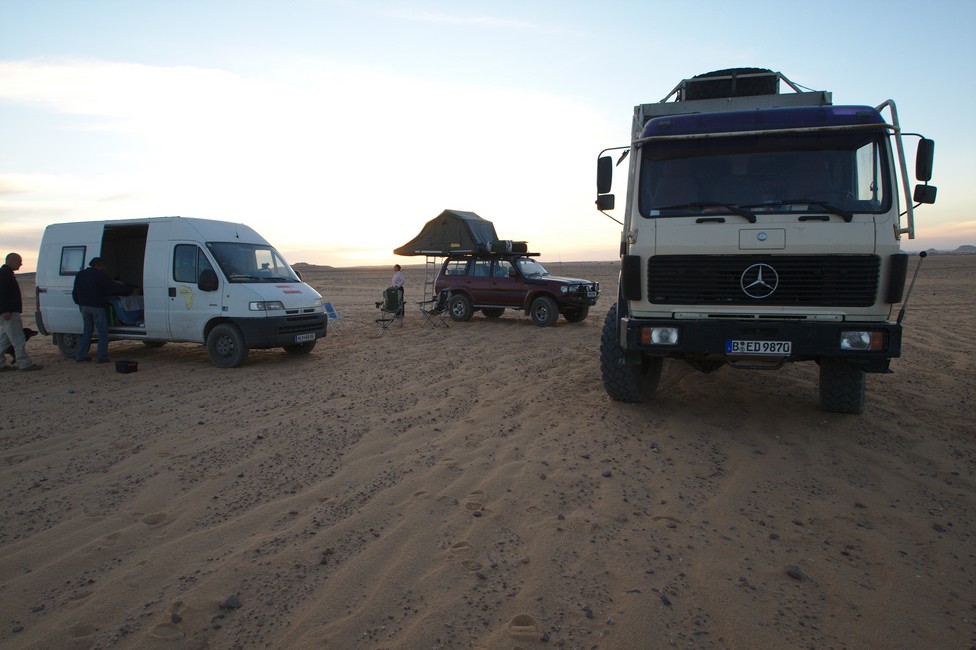
Since it is late, we are looking for a bush camp in the desert, Bruce and Petra join us.
Our desert camp
They live in England, but are from Africa. Bruce from South Africa, Petra is from a German family in Namibia. They use their trip for a visit to relatives. They spend their nights in their roof tent.
Tara enjoys being back with us after this adventurous voyage.
We still sit comfortably together and discuss our experiences on board the ferry. We still must go to Wadi Halfa for some paper work.
Next morning we are on the road again. From Wadi Halfa we drive on good tarmac in direction to Dongola. The landscape is fascinating and we are glad to be back on solid ground.
We knew very little about Sudan, so we are always amazed about the mud architecture and how buildings are built from this material.
We want to penetrate deeper into the mysteries of this country and turn off the asphalt road to drive closer at the Nile River.
The dirt road is good, solid ground, barely sandy passages and so we are making good progress. We already hold out for an overnight stay.
We want to find a place on the bank of the Nile River, which is not be visible from the road so we can spend a quiet night.
We find the seemingly perfect spot, overlooking the river, beautifully lonely. We get out to take pictures and prepare for a quiet night.
But it takes less than five minutes and we are attacked by insect swarms. They do not sting, but are annoying and we flee quickly in our vehicles. Later we will learn that here at the moment there is a fly infestation and the locals need to protect their faces with nets, that not thousands of flies get into all body openings.
It is a pity as it would have been a perfect setting for an overnight bush camp.
Wonderfully painted houses line the old main street. Before tarmac was attached this was the main route to the Sudan, the gravel road leads straight through the villages. Since the tar road villages are likely to suffer a little, as the business passes by their villages.
Finally, we find a place, but it’s getting late and we go to bed, we do not even notice the good view.
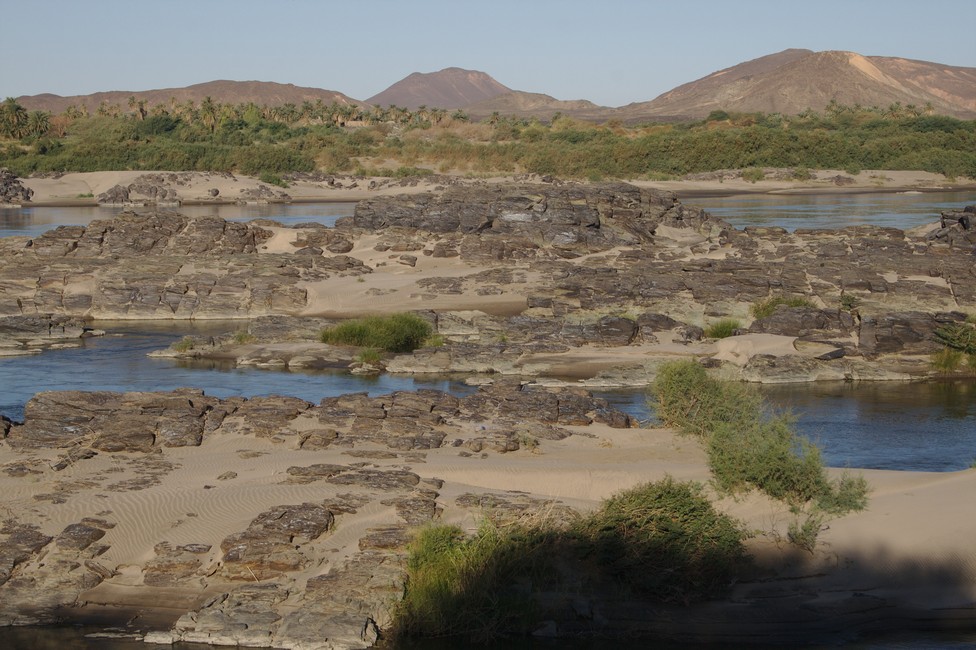
Only the next morning, we recognize the idyll. The Nile flows leisurely around an island out of stones with sand banks. A paradise.
At the Nile
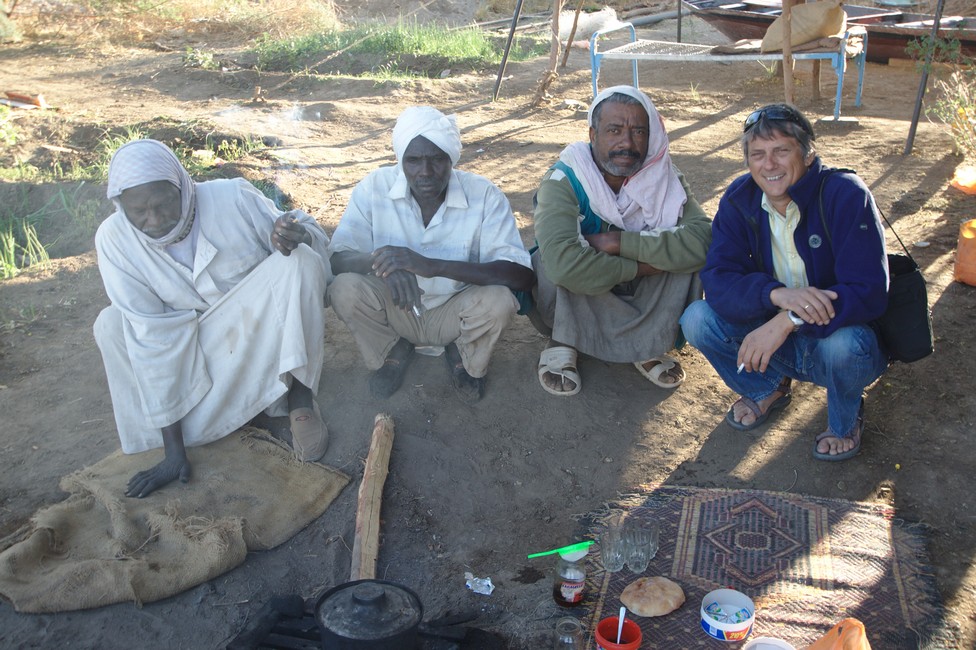
Only the rattle of a gasoline generator or a pump disturbs the idyll. We look at where the sound comes from and meet a group of men who by means of a pump, pump water from the Nile into tankers. The hospitality of the Sudanese people is great and now we sit with them and drink tea.
From hibiscus flowers they prepare good tea. The flowers are boiled in a kettle.
Since we do not speak Arabic, our conversation is limited to simple things that can be expressed also with hands and feet.
Getting in contact
Finally, the tea is poured into typical glasses, sweetened with strawberry jam and ready is breakfast tea.
We sit a while with the men and talk about this and that and enjoy the view of the Nile.
We are once again surprised by how friendly people are here. We need to straighten our image of Sudan in our head, so much negative reports are on this country and its people, mostly from a very narrow perspective, which distorts the image and prejudice can arise that is out of place and inappropriate.
We take a look at the floods of the Nile and make our way because we want still come to Dongola.
The route winds through many villages along the Nile, so far we have only seen small towns in Sudan, Dongola is to be a major city, where we want to add stocks and look at the place closer. We are already very excited.
In the morning we are already on board the passenger ferry to cross Lake Nasser. Lake Nasser is a result of a huge Dam built to provide water. Katzmat which is the name of the cat and Tara have been travelling so far for around a night on the lake, we will be sailing one day and one night and should arrive together with the barge at about the same time in Wadi Halfa.
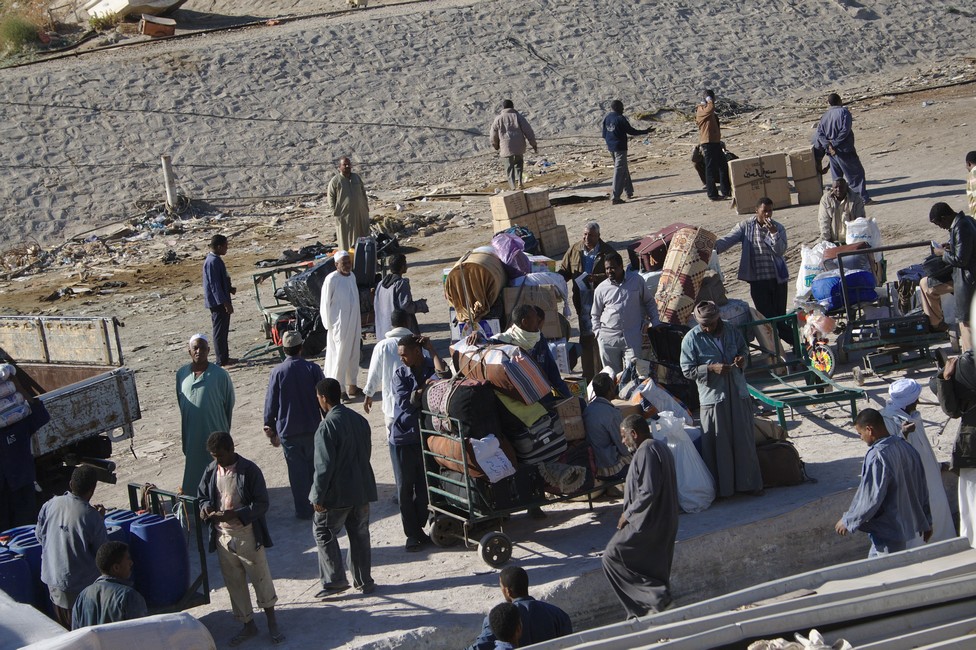
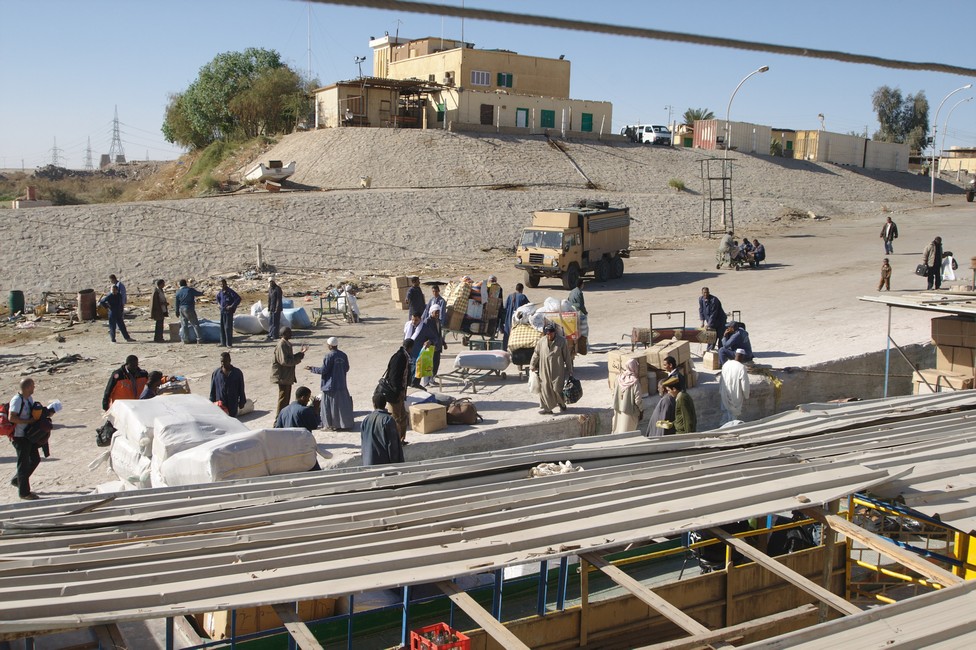
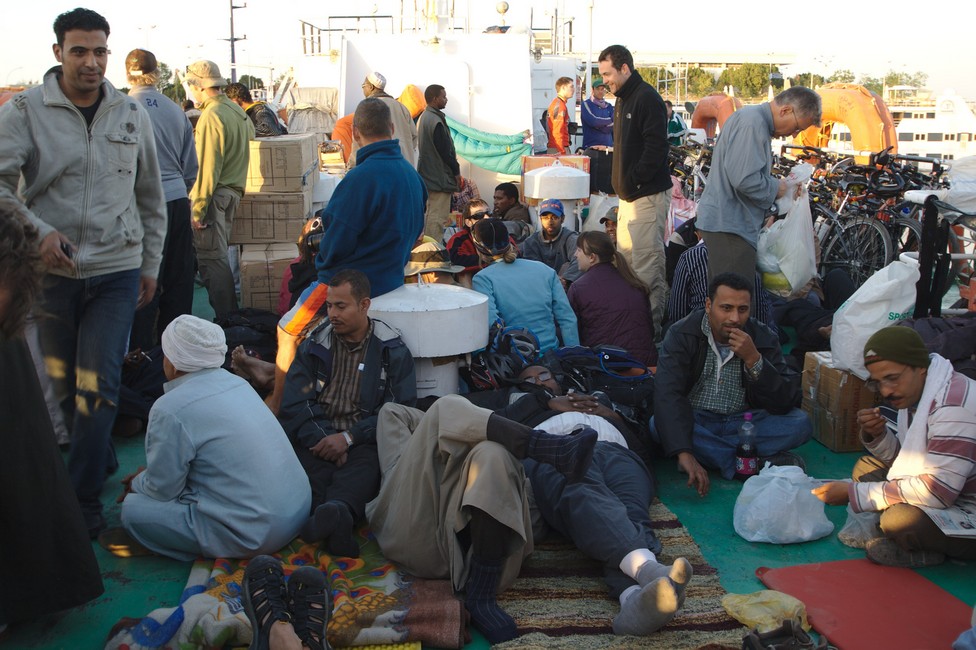
The ferry is being loaded with food. On board, we meet the three English biker we met in Cairo before. They make themselves comfortable on deck. You could also book cabins, but below deck, it is certainly sticky and so we spend the ride on deck.
Lake Nasser – Ferry is being loaded
Bine and Bodo find a wind-sheltered spot behind the chimney, we make ourselves comfortable below the rescue boat, which gives some shade as the sun burns relentlessly from the sky while a cold wind is blowing.
Since the early morning hours, the ferry is loaded continuously. Especially with food, we are confident that there will be meals.
We had already to be on board in the morning to try to get places, the vessel is to depart in the evening, so we have to wait. We observe the loading of the goods and the activities on the ferry.
For lunch there is a hot meal. We are served chicken with rice, vegetables and chapati, an Arabic bread, all on a metal tray. The food is delicious and shortens our waiting time before departure.
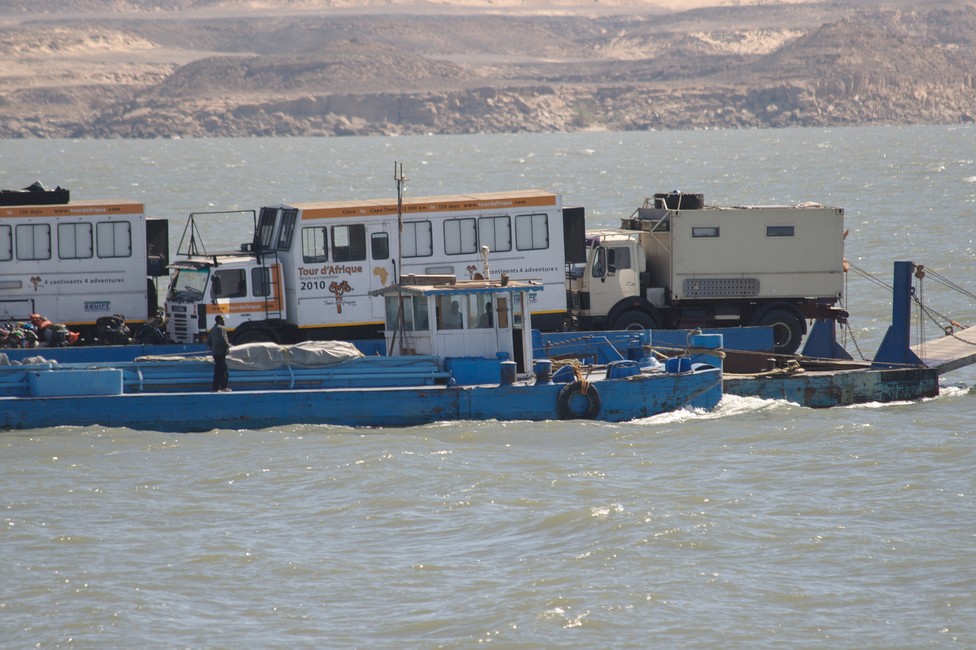
In the afternoon the loading of the regular barge starts. This will arrive in Wadi Halfa two days after our ship’s arrival.
It has space for three vehicles loaded transversely to the sailing direction.
Lake Nasser – trucks are loaded at a barge
Now come the Dutch with their Toyota Hilux. All old friends. Also, the young German couple with their three-axle Volvo emerges. We have met them in Cairo. They want to get until Nairobi, park their car there, fly back to work and continue their trip to Cape Town the following year.
There are only a few lunatics who undertake this crossing of Africa, and so you know each other, you meet again and again and exchange experiences. Those who start their trip in Europe start from there in autumn, so they come during the cooler months through the desert and reach Malawi and Zambia after the big African rainy season. We have planned like that as well but it will come differently.
Life on the ferry
Meanwhile it is evening and the ferry leaves. A whole day we spent waiting on the ship. Our journey takes us further on over Lake Nasser to Wadi Halfa, the port of entry into Sudan. From Wadi Halfa we want to go along the Nile to Dongola and continue along the Nile bow, then through the desert to Atbara. From there to Khartoum, the capital of Sudan, and to Metema into Ethiopia.
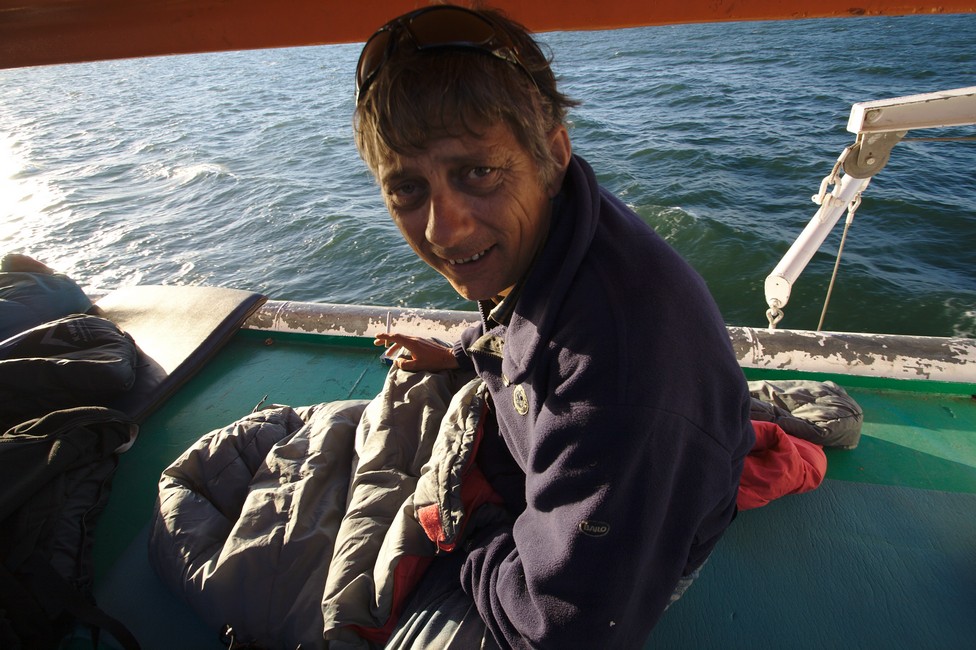
Finally we have survived the night on the crowded ferry, although sleeping at the edge of the ferry close to the water without railing should not allow a pleasant sleep, but we were tired. But we were well off, had at least space to stretch and the muezzin at 5 clock in the morning was bearable.
After a cold and dangerous night
After morning coffee, the call comes to the doctor. Yes, all passengers must undergo an examination. The doctor measures the temperature, only those with no fever may enter into Sudan. We have quite a lot of fun with the physican, he takes it on the bright side as well.
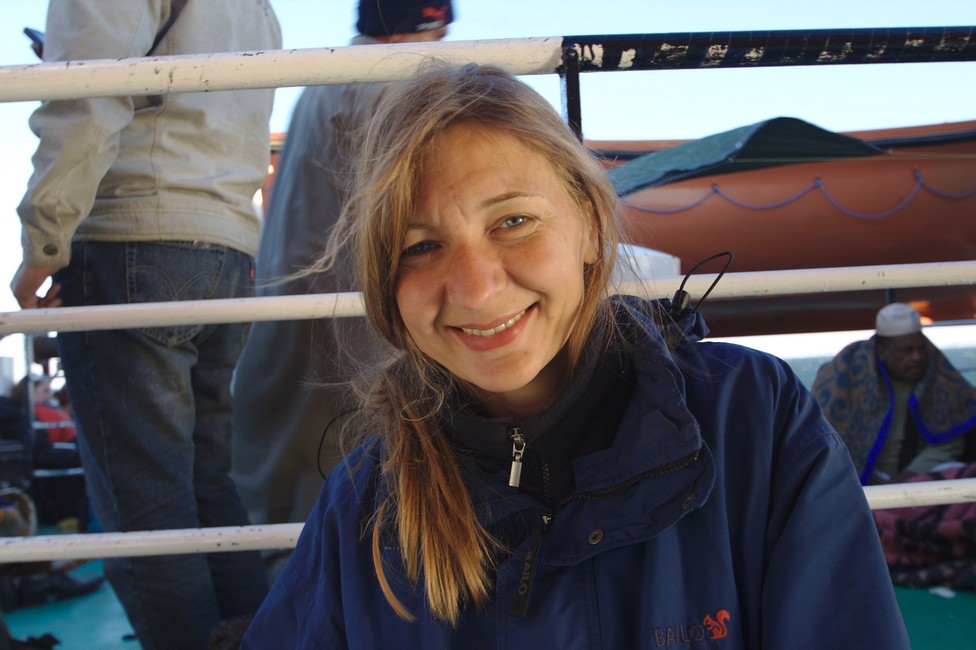
Alexandra in the morning
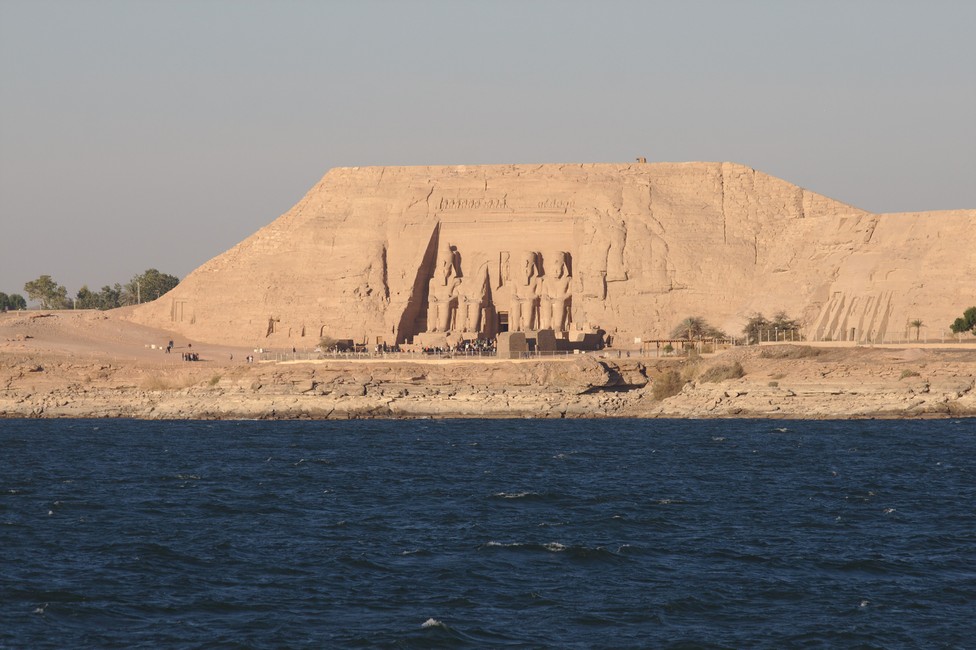
In the distance from the middle of Lake Nasser Abu Simbel comes into sight, which is still in Egypt. Light illuminates the rock in the morning light. There are two temples, the great temple of Ramses II and the Hathar temple.
Abu Simbel
As we get closer, we can see the four seated statues of Ramses, who look majestic to the lake, earlier here was only desert, the lake was not there by then. We must hand over our passports because we approach Wadi Halfa. We can not wait getting Tara back healthy.
Suddenly in the distance we see our barge. We are trying to recognize anything. While we can see Bodo’s and our car, we cannot see Tara the distance is too far. We have to wait.
In the morning, we’re early in the harbor of Aswan. We must handle all the customs formalities, our Carnet de Passage must be stamped correctly, this will take some time, then comes the loading procedure and the captain we need to visit, because of Tara.
Aswan Egypt – Lake Nasser
Bruce an Anglo-South African, which we have previously met in Aswan observes skeptically the whole action. Formalities take time, and we only continue slowly.
It is already late afternoon by now and we start loading the vehicles. On our barge are two Overlander Trucks, our camper van, Bodo’s Truck and the SUV of Bruce. I wonder if we all fit on it.
The Overlander trucks are the first, they might have rented the barge, next is Bodo’s turn.
Bruce is still ahead of us in line, we are the last, an impenetrable system. Vehicles must be arbitrated. Even when buying the tickets in Aswan Mr. Salah from the ferry company had to measure the vehicles as every inch matters. At the first sight of the barge I am full with horror, the loading bay is in a memorable bad condition, even the barge itself makes no safe impression on me, I wish I could turn back now, but it’s too late, our vehicles have left the country officially.
All come running to see the spectacle of loading. It is truly a spectacle, because one has the impression that the sailors are not sure of what they are doing, because it is much debated. The Overlander Truck must return again and has to embarque the barge in a different angle.
Miraculously, it is finally at the barge, here many things happen Inshala, Allah will sort things out.
I insist to embarque the barge in reverse, so that the sliding door is facing the ship’s center. After much discussion, I can finally prevail only with threats. The mood is tense. They do not understand that the sliding door can not directly open to the water, otherwise when our dog gets out and in, there is the risk that she falls into the lake. I have to chain our dog to the car, because Tara must be able to get inside the car during night as they are pretty cold and must be able to get under the car to be protected from the heat of day.
The loading dock is unbelievable. It would have been possible to buy for little money two regular wooden ramps. But the operator does not seem interested and promptly the ramp breaks while I drive over it. The result is that the frame of our camper van is damaged. No compensation of course.
After much tinkering and getting other creative tools, it is possible eventually to bring the vehicle onto the barge, now it has only be brought into position.
The parking is precision work and it gets pretty tight on the boat. I have the impression that the vehicle widths were not calculated.
The drivers of the Overlander trucks have simply disappeared, so the trucks can not be moved, too bad for us and so it is much harder with the shipment.
Finally, I am standing in the parking position. Tara needs to be supplied with food and water, sliding door opened, the promised supervisor did not appear, so I ask the captain to give attention to the dog, luckily he is related with Ashraf.
Bodo finally came as the last on the barge, he hangs over a little with his back, stones are put behind the wheels so that it does not roll off the barge when heavy waves.
The wall is wound up, and the pontoon sets off. I have a bad feeling, I’m very concerned about Tara, will she survive the two days, will the captain really feed her, I am waving her goodbye. Bodo is concerned about the cat. It must stay in the car, locked, windows can be opened only a crack, otherwise the cat escapes, we hope that it is not too hot in the truck.
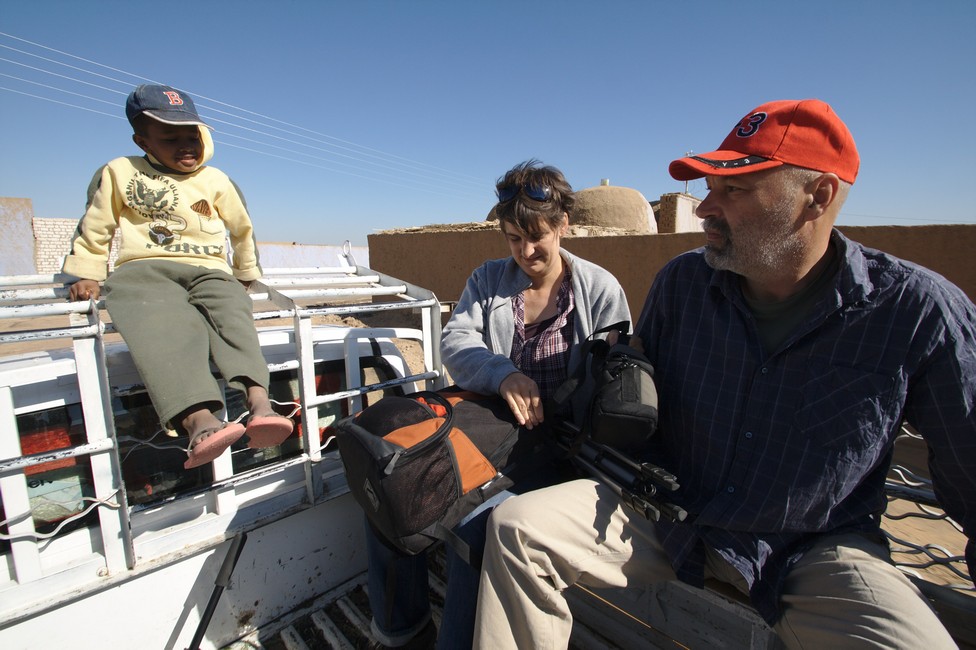
In the morning we go with him and his son in an open pick up down to the Nile to make a Nile cruise.
Pickup to the Boat. Ashrafś son and our friends Bodo and Bine
Of course, we attract a lot of attention because foreigners are only rarely seen on this side of the Nile, and so the children shout and wave friendly.
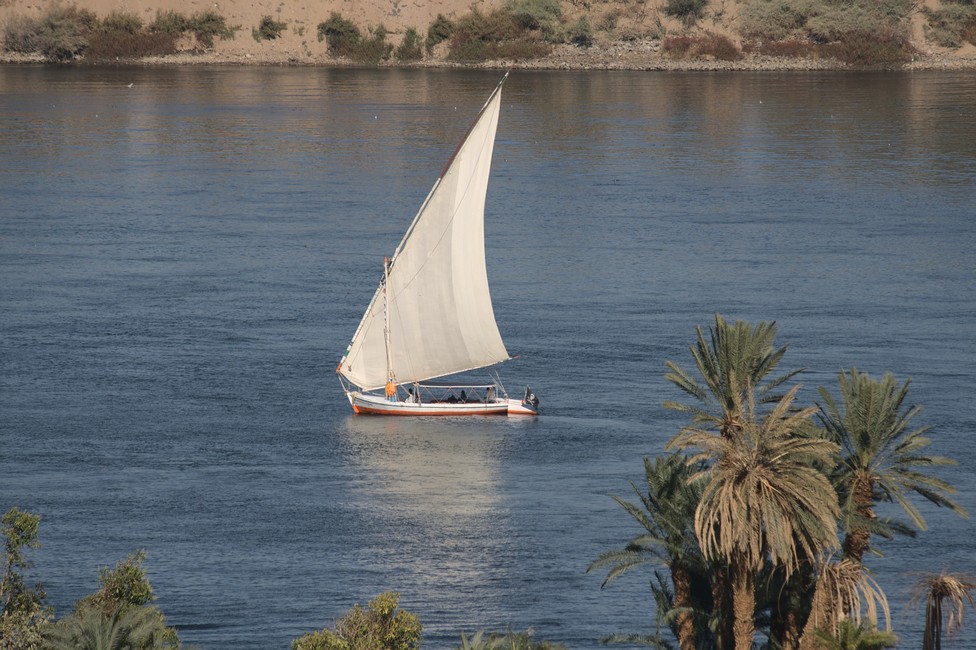
Felucca on the Nile
We are very happy, because a ride on a felucca is certainly a highlight of our trip. The morning air is cool and the wind freezes us, but to the Nile it is only a stone’s throw away.
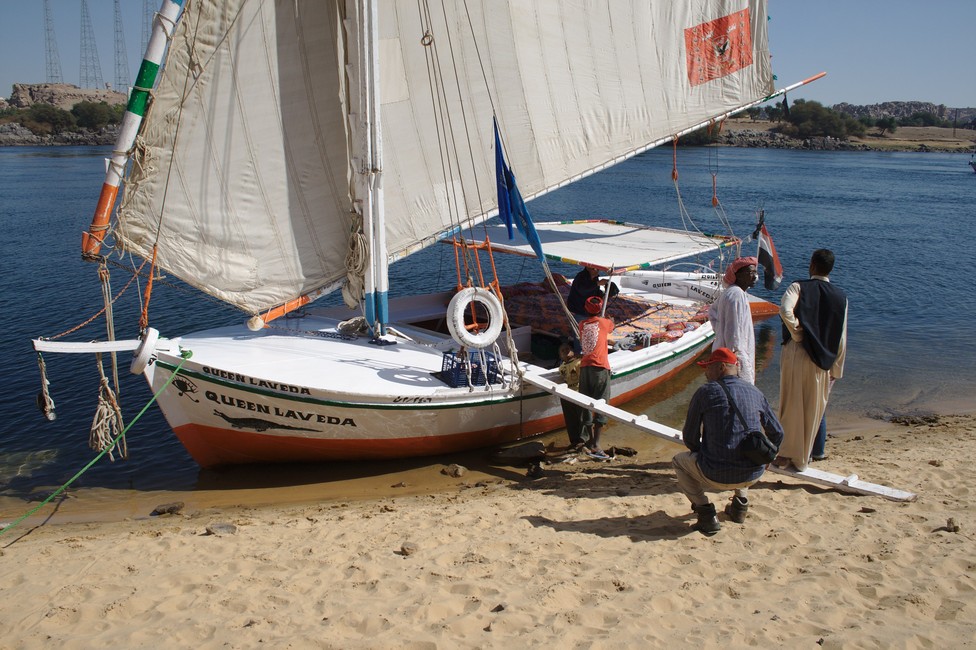
On the shore there are several boats, including that of Ashraf. It was a gift from a friend to him and the Captain is enormously proud of his ship. On the boat all the preparations for departure are already going on. It is cleaned and polished, food is loaded on board and the pillows are placed.
Not only his son but also his cousin comes with us on this exciting Nile cruise. He is responsible for maintenance of the felucca, and he takes his job very seriously. He is passionately at work.
We can not help and thus we enjoy the atmosphere at the bank. A Nubian boy is scrubbing the deck. He is also the cook and he will spoil us culinarily. Our plan is to sail up the river Nile to the ancient dam, and we want to visit a village as well. Ashraf’s son is charming and already knows how to fascinate the ladies! Last but not least, the sail is hoisted. The captain himself is climbing up the mast. The hoisting of the sail requires not only skill, but also power, for everything must be done by hand.
The cabin boy pushes the boat from the shore. Now off we go on our Nile cruise. It will be sailed directly from the shore. There is no engine, as is common in sports or recreational sailing yachts. We learn much about the Nubians and the felucca. Ashraf tells us about the history of his people and the Nile.
Nile Cruise on the Felucca
Ashraf’s family on one hand lives in Egypt, on the other hand, in Sudan. Even the Sudanese part of his family owns feluccas, which transport goods on the Nile at Dongola. Feluccas have a long tradition on the Nile. Even in the days of the pharaohs they were built, were originally made of papyrus , and soon they have reached their present form, and since that time have not significantly altered.
We are fascinated by the felucca ride. Quietly the boat glides across the water. The landscape is passing slowly and steadily, there are interesting things to observe. Many new impressions collapse on us, occupy our thoughts. Many things Ashraf must explain, a lot is new to us.
Nile
Frantically boats with tourists pass, they have unfortunately not the time to navigate the Nile slowly and leisurely.
In many places, the dunes reach up to the banks of the Nile, only where the desert has been reclaimed by irrigation of farmland, it is green and allows survival.
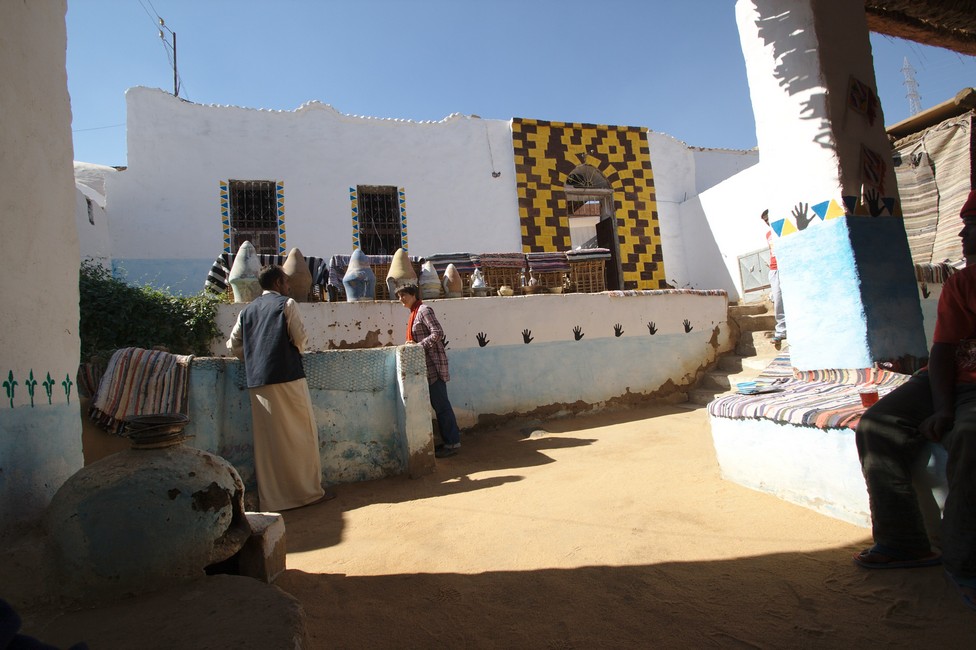
Finally, we anchor at a Nubian village. The team remains in the felucca as we climb up to the Crocodile house. It is a typical Nubian mud house, which serves as a restaurant.
Ashrafs Felucca
Bodo admires a crocodile, which is kept in a wretched dungeon. In the past there have been crocodiles here in this section of the Nile. Today, however, they are extinct here.
We refresh ourselves in the shade of the patio with a cool drink, before returning on board the felucca. The shoes must be put off before entering the felucca.
Restaurant
Now we go direction of the old dam. We are still less than 10 minutes on the river, when we run aground in a difficult part of the Nile.
Well, the boat has to be freed from this unfortunate situation. The captain leaves in this case first the sinking ship to save what can still be saved.
It really stucks heavily at the rock and they cannot get it off the rock. Thank God the body is not damaged and no water spills into the boat.
Finally, it is possible with united forces and violent swings to get it free from the rock.
The captain must strengthen himself after this horror with a cup of tea. Finally we were lucky.
The waters here are tricky. On one hand, the Nile is not very wide here due to a number of rocky islands thus strong currents prevail here, that squeeze through the rocks and take on a high flow rate. Furthermore, there are rapidly changing wind conditions and the captain has to maneuver the sailboat quickly and skillfully. Although it now goes downstream, we sail against the wind, making an incessant cruising necessary. Undeterred by the events the boy is preparing tea and makes himself ready for dinner’s preparation. It soon will be served.
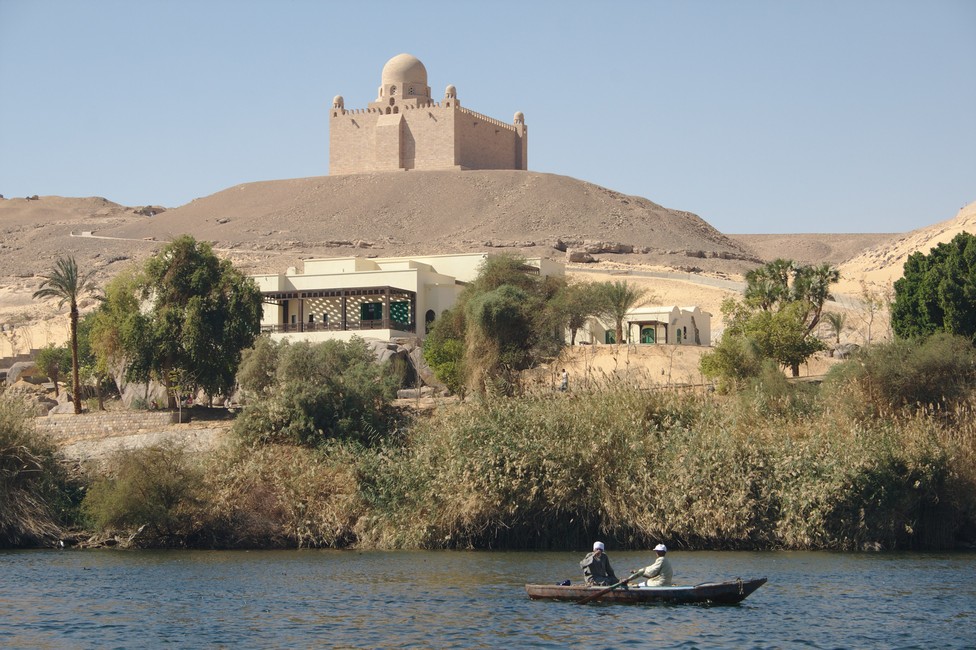
We are approaching again the center of Aswan. Many boats anchor here. In the middle of the Nile there is the island of Elephantine. There is a so-called Nilometer. The Nilometer served to indicate the water level. Through a corridor the water gets to a basin where the measurement scale begins. They measured in an old Roman system. Elephantine Island can be reached from the center of Aswan with small ferries. There can be visited historic places of worship. Here also the great Nile cruisers anchor, Aswan is the last stop on the Nile, further up the river can no longer be sailed by these ships.
At full speed we are provided with the ingredients for dinner. Ashraf’s second boat comes to the felucca. Now the cook starts with dinner. We are surprised that there even is an oven at the felucca. The harness is stowed in the bow, the cooker runs on gas. For dinner we anchor on the banks of the Nile. The felucca is constructed that way it can get to almost any type of shore. Ashraf looks for an idyllic place.
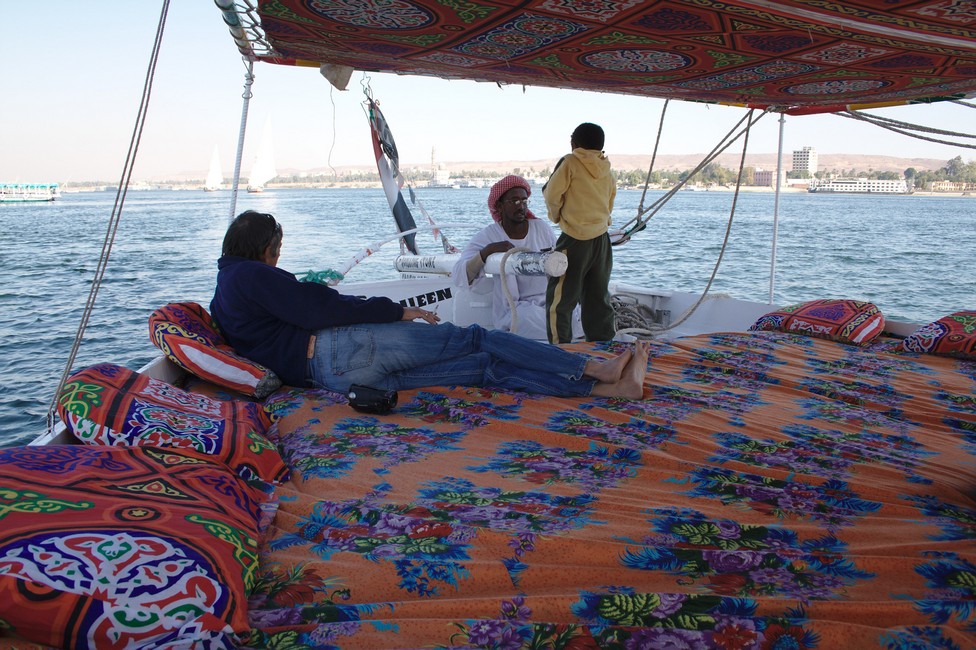
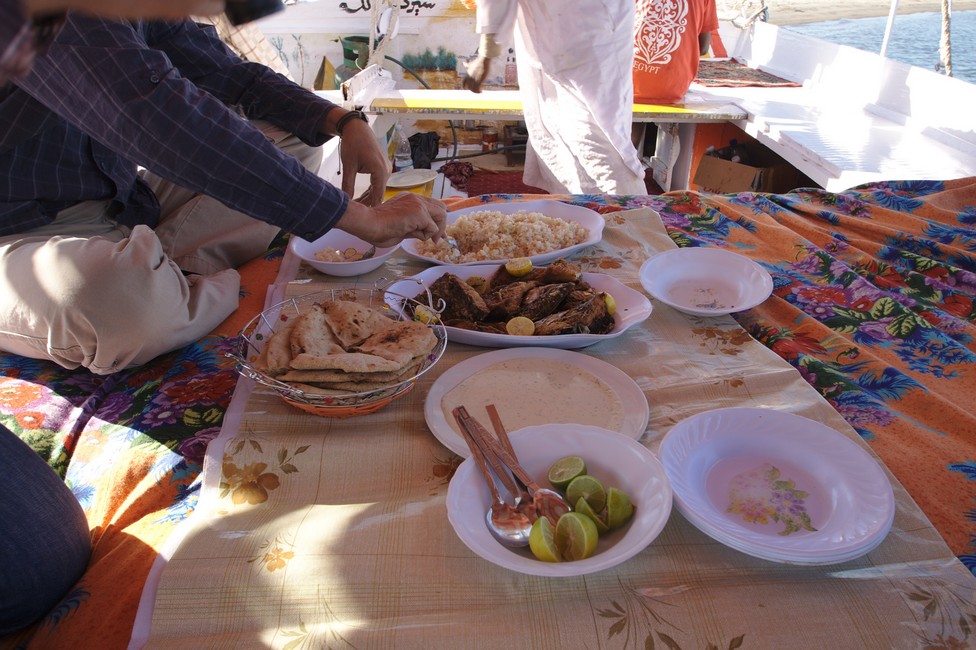
On the couch cushions, a blanket is spread, we eat sitting on the floor as is usual with the Nubians. A tradition that has already maintained by the ancient Romans.
Lunch on the Felucca
There are wonderful fish and delicious side dishes, what we did not expect and are happy about this surprise. We enjoy a delicious meal with great views of the Nile and the passing ships. Immediately after the meal we have to continue with our Nile cruise again, because the wind has subsided and we are proceeding with difficulty. Fishing boats we meet in the light of the slowly setting sun.
Sadness is coming up, it will be one of our last days in Egypt. Tomorrow is the day that is so much feared by us, we have to load our cars onto the ferry and our dog Tara must be left alone on the boat for two days.